

Aravind Narayan
Increasingly sophisticated fraud attacks are forcing organisations to rethink how they verify identity online. Against this backdrop, the European Digital Identity (EUDI) framework marks a significant shift in how individuals can prove who they are across Europe.
At a glance:
- The EUDI framework will reshape digital identity across Europe, with all EU member states required to provide at least one EUDI Wallet by December 2026.
- Consumers will gain greater control over their personal data by design, including the ability to selectively disclose identity information and manage how it is shared.
- Organisations need to prepare now to integrate EUDI into their workflows, whilst limiting customer friction.
Fraud erodes trust
Fraud is rising across the globe, eroding trust in digital finance and fundamentally changing how people interact with online services. It creates emotional and behavioural damage, with many struggling to navigate its aftermath.
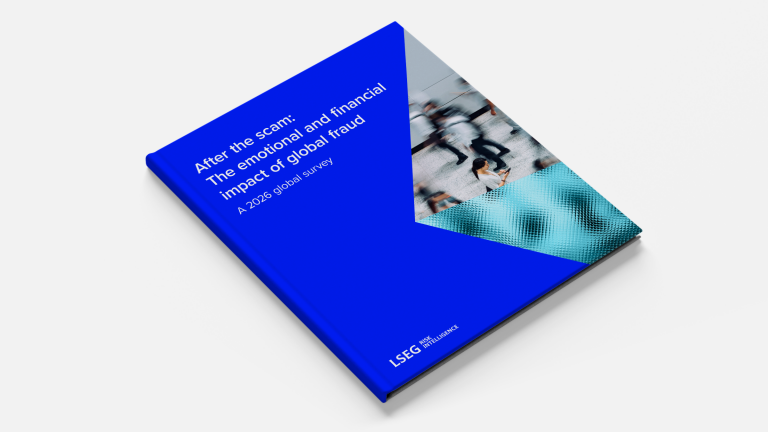
LSEG's Global Fraud Report, which looked at how 21,000 adults across the globe perceive fraud risk, found that 29% of adults have lost trust in people and companies following a scam. When consumers lose confidence in digital interactions, it weakens the trust that underpins the broader digital ecosystem. 37% of fraud victims avoid certain types of transactions or channels in the wake of a scam, limiting industry impacts.
It is also important to recognise that fraud has evolved far beyond the use of stolen or forged documents. Today, organisations face increasingly sophisticated threats, including synthetic identities, deepfakes, and account opening fraud. As fraudsters leverage AI and automation to scale their attacks, traditional prevention methods alone are no longer sufficient. Businesses need modern identity verification solutions that can adapt to an increasingly complex and AI-driven threat landscape.
One of the most significant developments is the European Digital Identity (EUDI) framework, an EU-wide initiative designed to create a trusted and interoperable digital identity ecosystem across member states.
EUDI is changing how identity can be established and trusted
Through EUDI Wallets, individuals will be able to securely store, manage and share verified identity information and other trusted credentials online. The framework aims to make digital interactions more secure, private and consistent across Europe while giving users greater control over their personal data. Ultimately, the EUDI framework is intended to support security in cross-border digital interactions, but also to deliver more privacy and user control.
Yet, for organisations, EUDI introduces new considerations around controlled scaling and integration, whilst meeting regulatory requirements.
How the EUDI framework changes identity verification
The EUDI framework brings several changes, most significantly:
- Faster and more consistent cross-border onboarding
The EUDI framework is designed to make cross-border digital identity easier. EUDI Wallets will enable users to present trusted identity information through their wallets when accessing participating services across Europe.
- Greater privacy and customer trust through selective disclosure
EUDI Wallets support selective disclosure, allowing users to share only the information required for a specific transaction rather than an entire identity record. This supports data minimisation and privacy by design.
- The ability to add more credentials and move beyond basic identity information
The EUDI framework supports the addition of more credentials, which allows trusted information beyond core identity data to be presented digitally. Examples can include qualifications and other verified attributes.
- The ability to manage digital identity and data sharing
Users will be able to see which relying parties they have interacted with and, where applicable, what information has been shared. Existing GDPR rights, including the rights to data portability and to request the erasure of personal data, continue to apply where relevant.
- New layer of safety
EUDI Wallets are expected to operate at a high assurance level and use cryptographically signed data. This can support stronger identity assurance compared with traditional identity processes.
It is time to prepare for EUDI
There are some important EUDI dates to keep in mind:
- December 2026: Under the revised eIDAS framework, all 27 EU member states must provide at least one EUDI Wallet. However, adoption is unlikely to be uniform, with some countries expected to progress more quickly than others. Organisations operating across multiple markets will need to navigate different levels of digital identity maturity and adoption.
- December 2027: EUDI Wallet acceptance becomes mandatory for certain regulated sectors. Private organisations such as banks, financial services firms and Very Large Online Platforms (VLOPs) will be required to accept EUDI Wallets under the revised eIDAS framework.
With EUDI implementation timelines progressing, organisations that expect to rely on EUDI Wallets should begin preparing for relying party registration in their Member State of establishment, in line with Article 5b requirements. Further, organisations must consider EUDI within their broader identity strategy and prepare to support trusted digital identities.
Managing EUDI complexity at scale
While EUDI simplifies digital identity for consumers, it may increase complexity for organisations that need to support multiple wallets, credentials and verification methods. One approach to managing this complexity is the use of a unified identity orchestration platform. One way to manage this complexity is through identity orchestration: connecting to multiple trusted digital identity schemes through a single integration, rather than building and maintaining each one separately.
This approach can give customers more choice in how they prove who they are, whether through an EUDI Wallet, a national digital identity scheme or another trusted provider. At the same time, it helps organisations reduce onboarding friction and keep the verification experience consistent across markets. It can also make it easier to support new schemes as adoption grows, without redesigning onboarding journeys each time.
EUDI represents one of the most significant changes to digital identity in Europe in recent years. Organisations that begin planning now will be better positioned to deliver trusted customer experiences, strengthen identity assurance and meet evolving regulatory requirements as adoption accelerates.
Find out how you can strengthen identity assurance across markets without adding friction or operational overhead.

Legal Disclaimer
Republication or redistribution of LSE Group content is prohibited without our prior written consent.
The content of this publication is for informational purposes only and has no legal effect, does not form part of any contract, does not, and does not seek to constitute advice of any nature and no reliance should be placed upon statements contained herein. Whilst reasonable efforts have been taken to ensure that the contents of this publication are accurate and reliable, LSE Group does not guarantee that this document is free from errors or omissions; therefore, you may not rely upon the content of this document under any circumstances and you should seek your own independent legal, investment, tax and other advice. Neither We nor our affiliates shall be liable for any errors, inaccuracies or delays in the publication or any other content, or for any actions taken by you in reliance thereon.
Copyright © 2026 London Stock Exchange Group. All rights reserved.
The content of this publication is provided by London Stock Exchange Group plc, its applicable group undertakings and/or its affiliates or licensors (the “LSE Group” or “We”) exclusively.
Neither We nor our affiliates guarantee the accuracy of or endorse the views or opinions given by any third party content provider, advertiser, sponsor or other user. We may link to, reference, or promote websites, applications and/or services from third parties. You agree that We are not responsible for, and do not control such non-LSE Group websites, applications or services.
The content of this publication is for informational purposes only. All information and data contained in this publication is obtained by LSE Group from sources believed by it to be accurate and reliable. Because of the possibility of human and mechanical error as well as other factors, however, such information and data are provided "as is" without warranty of any kind. You understand and agree that this publication does not, and does not seek to, constitute advice of any nature. You may not rely upon the content of this document under any circumstances and should seek your own independent legal, tax or investment advice or opinion regarding the suitability, value or profitability of any particular security, portfolio or investment strategy. Neither We nor our affiliates shall be liable for any errors, inaccuracies or delays in the publication or any other content, or for any actions taken by you in reliance thereon. You expressly agree that your use of the publication and its content is at your sole risk.
To the fullest extent permitted by applicable law, LSE Group, expressly disclaims any representation or warranties, express or implied, including, without limitation, any representations or warranties of performance, merchantability, fitness for a particular purpose, accuracy, completeness, reliability and non-infringement. LSE Group, its subsidiaries, its affiliates and their respective shareholders, directors, officers employees, agents, advertisers, content providers and licensors (collectively referred to as the “LSE Group Parties”) disclaim all responsibility for any loss, liability or damage of any kind resulting from or related to access, use or the unavailability of the publication (or any part of it); and none of the LSE Group Parties will be liable (jointly or severally) to you for any direct, indirect, consequential, special, incidental, punitive or exemplary damages, howsoever arising, even if any member of the LSE Group Parties are advised in advance of the possibility of such damages or could have foreseen any such damages arising or resulting from the use of, or inability to use, the information contained in the publication. For the avoidance of doubt, the LSE Group Parties shall have no liability for any losses, claims, demands, actions, proceedings, damages, costs or expenses arising out of, or in any way connected with, the information contained in this document.
LSE Group is the owner of various intellectual property rights ("IPR”), including but not limited to, numerous trademarks that are used to identify, advertise, and promote LSE Group products, services and activities. Nothing contained herein should be construed as granting any licence or right to use any of the trademarks or any other LSE Group IPR for any purpose whatsoever without the written permission or applicable licence terms.