
LISTEN TO THE PODCAST
Catherine Yoshimoto, director of product management at FTSE Russell, recently joined the Index Ideas podcast to talk about an expansion of the Russell Indexes framework to cover global equity markets.
The new Russell 9000 Global index builds on the 40-year history of the Russell index series to bring together US, developed ex-US and emerging markets stocks in a single benchmark.
“More than ever, market participants are looking globally for equity investment opportunities,” Yoshimoto says in the podcast.
“Capital is allocated across regions. And benchmarks that consistently reflect the full opportunity set play an increasingly important role.”
“FTSE Russell has designed a representative and investable global equity benchmark using the familiar, trusted Russell framework, with more than $12 trillion in assets benchmarked, building confidence through clarity, consistency and transparency.”
The Russell 9000 Global index follows the same modular design approach as the Russell US Indexes, where a broad 3,000-stock benchmark is divided into a large-cap index of 1,000 stocks (the Russell 1000) and a small-cap index (the Russell 2000).
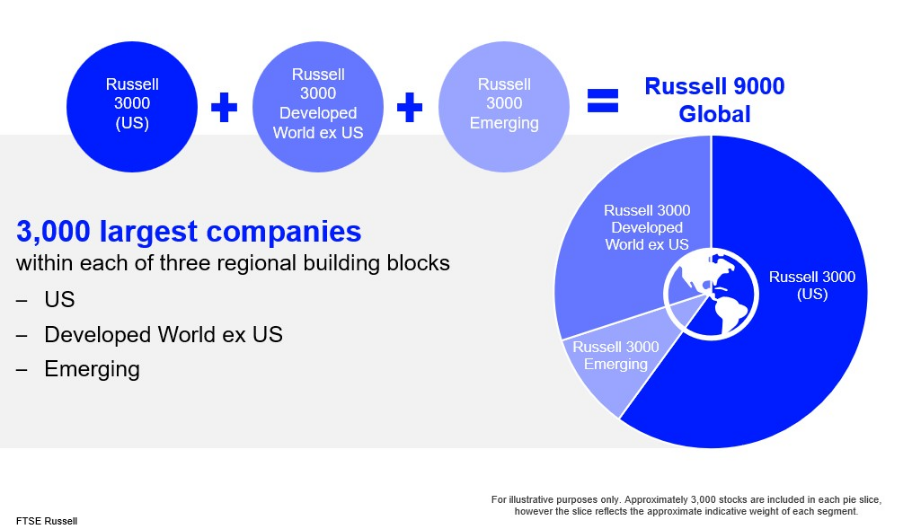
In the case of the Russell 9000 Global, the extra two building blocks are the Russell 3000 Developed World ex US and the Russell 3000 Emerging.
“The Russell 9000 Global is built using a single, seamless methodology across regions, which helps avoids gaps, overlaps and boundary inconsistencies,” says Yoshimoto.
“By contrast, combining multiple indexes constructed under different methodologies can introduce unintended coverage issues, such as double-counting securities or missing parts of the investable universe.”
Three core building blocks for the Russell 9000 Global
To watch the Index Ideas podcast featuring Catherine Yoshimoto, click here.
There’s no standardisation amongst global equity benchmarks, with popular indices including anywhere between 8,000 and over 10,000 stocks. So why does the Russell 9000 have a constituent count roughly in the middle of that range?
“A 9000-company target captures the vast majority of global investable equity market capitalisation while maintaining liquidity, scalability, and practical investability,” Yoshimoto says.
“This breadth strikes a deliberate balance relative to peer global equity benchmarks, covering neither too many nor too few stocks in the global opportunity set.”
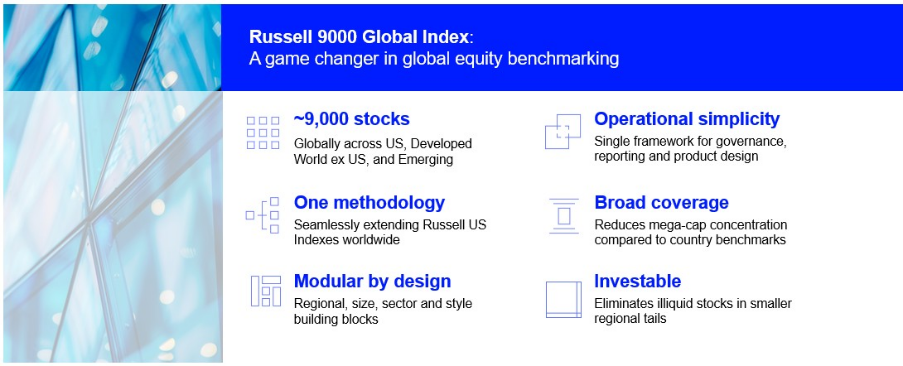
Russell 9000 Global Index: benefits at a glance
In the Russell 9000 Global, companies are ranked by total market capitalisation from largest to smallest as of a rank date and index weights reflect float-adjusted market capitalisation, supporting investability while providing broad and objective representation of the global equity market.
The rebalancing schedule aligns with the existing Russell US indexes’ reconstitution schedule, so the reconstitution for Russell 9000 Global will also occur twice a year, on the fourth Friday of June and the second Friday of December.
To maximise investability, the Russell 9000 Global prioritises American Depositary Receipts (ADRs) when they are more liquid than local listings, while ensuring each company is represented at its true market cap, avoiding double counting.
Russell's methodology also ensures the inclusion of companies that do not have a liquid local listing: that is, firms which may only be investable through ADRs.
According to Yoshimoto, the new global equity benchmark will provide a comprehensive framework for a variety of financial market participants.
“From ETFs to model portfolios, especially for those who already use the Russell US indexes, the Russell 9000 Global helps them move seamlessly into global markets and provides a consistent foundation for global equity investing, supporting benchmarking, asset allocation and portfolio construction,” she says.
Russell 9000 Global Index: a broader, more consistent global framework
| Global policy benchmark alignment (asset owners, active managers) | Product design and ETF innovation | Model portfolio and wealth platform construction | |
|---|---|---|---|
| Objective | Replace fragmented global benchmarks with a simpler, consistent framework at a lower cost | Build differentiated global equity products | Build consistent global equity exposures across regions, size segments, and client risk profiles |
| How Russell 9000 Global helps | Extends existing Russell US exposure globally Uses a simple, count-based methodology across regions Eliminates benchmark mismatch |
Access to a broad opportunity set with ~9,000 stocks globally Reduce influence of mega-cap concentration Provides modular building blocks (US, Developed ex US, Emerging) |
Provides modular US, Developed World ex US, and Emerging components within one methodology |
| Client benefit | Lower total benchmarking cost for existing Russell US clients Improved governance and transparency More rules-driven consistency and diversified long-term allocation |
Balanced representation compared to traditional global benchmarks Clear and differentiated product positioning Flexible construction for ETFs, models, and SMAs |
Easier model construction, cleaner manager mapping, and consistent portfolio oversight |
To listen to the Index Ideas podcast featuring Catherine Yoshimoto, click here.


Disclaimer
© [2026] London Stock Exchange Group plc and its applicable group undertakings (“LSEG”). LSEG includes (1) FTSE International Limited (“FTSE”), (2) Frank Russell Company (“Russell”), (3) FTSE Global Debt Capital Markets Inc. “FTSE Canada”, (4) FTSE Fixed Income LLC (“FTSE FI”), (5) FTSE (Beijing) Consulting Limited (“WOFE”), (6) FTSE EU SAS ("FES"). All rights reserved.
FTSE Russell® is a trading name of FTSE, Russell, FTSE Canada, FTSE FI, WOFE, FTSE EU and other LSEG entities providing LSEG Benchmark and Index services. “FTSE®”, “Russell®”, “FTSE Russell®”, “FTSE4Good®”, “ICB®”, “Refinitiv”, “WMR™” “FR™” and all other trademarks and service marks used herein (whether registered or unregistered) are trademarks and/or service marks owned or licensed by the applicable member of LSEG or their respective licensors.
FTSE International Limited is authorised as a Benchmark Administrator and regulated in the United Kingdom (UK) by the Financial Conduct Authority ("FCA") according to the UK Benchmark Regulation, FCA Reference Number 796803. FTSE EU SAS is authorised as Benchmark Administrator and regulated in the European Union (EU) by the Autorité des Marches Financiers (“AMF”) according to the EU Benchmark Regulation.
All information is provided for information purposes only. All information and data contained in this publication is obtained by LSEG, from sources believed by it to be accurate and reliable. Because of the possibility of human and mechanical inaccuracy as well as other factors, however, such information and data is provided "as is" without warranty of any kind. No member of LSEG nor their respective directors, officers, employees, partners or licensors make any claim, prediction, warranty or representation whatsoever, expressly or impliedly, either as to the accuracy, timeliness, completeness, merchantability of any information or LSEG Products, or of results to be obtained from the use of LSEG products, including but not limited to indices, rates, data and analytics, or the fitness or suitability of the LSEG products for any particular purpose to which they might be put. The user of the information assumes the entire risk of any use it may make or permit to be made of the information.
No responsibility or liability can be accepted by any member of LSEG nor their respective directors, officers, employees, partners or licensors for (a) any loss or damage in whole or in part caused by, resulting from, or relating to any inaccuracy (negligent or otherwise) or other circumstance involved in procuring, collecting, compiling, interpreting, analysing, editing, transcribing, transmitting, communicating or delivering any such information or data or from use of this document or links to this document or (b) any direct, indirect, special, consequential or incidental damages whatsoever, even if any member of LSEG is advised in advance of the possibility of such damages, resulting from the use of, or inability to use, such information.
No member of LSEG nor their respective directors, officers, employees, partners or licensors provide investment advice and nothing in this document should be taken as constituting financial or investment advice. No member of LSEG nor their respective directors, officers, employees, partners or licensors make any representation regarding the advisability of investing in any asset or whether such investment creates any legal or compliance risks for the investor. A decision to invest in any such asset should not be made in reliance on any information herein. Indices and rates cannot be invested in directly. Inclusion of an asset in an index or rate is not a recommendation to buy, sell or hold that asset nor confirmation that any particular investor may lawfully buy, sell or hold the asset or an index or rate containing the asset. The general information contained in this publication should not be acted upon without obtaining specific legal, tax, and investment advice from a licensed professional.
Past performance is no guarantee of future results. Charts and graphs are provided for illustrative purposes only. Index and/or rate returns shown may not represent the results of the actual trading of investable assets. Certain returns shown may reflect back-tested performance. All performance presented prior to the index or rate inception date is back-tested performance. Back-tested performance is not actual performance, but is hypothetical. The back-test calculations are based on the same methodology that was in effect when the index or rate was officially launched. However, back-tested data may reflect the application of the index or rate methodology with the benefit of hindsight, and the historic calculations of an index or rate may change from month to month based on revisions to the underlying economic data used in the calculation of the index or rate.
This document may contain forward-looking assessments. These are based upon a number of assumptions concerning future conditions that ultimately may prove to be inaccurate. Such forward-looking assessments are subject to risks and uncertainties and may be affected by various factors that may cause actual results to differ materially. No member of LSEG nor their licensors assume any duty to and do not undertake to update forward-looking assessments.
No part of this information may be reproduced, stored in a retrieval system or transmitted in any form or by any means, electronic, mechanical, photocopying, recording or otherwise, without prior written permission of the applicable member of LSEG. Use and distribution of LSEG data requires a licence from LSEG and/or its licensors.