

Catherine Yoshimoto
When the Russell 2000® index was launched in 1984, it broke new ground as the first benchmark dedicated to small-cap stocks. For institutional investors, this was a game-changer—providing a way to measure a different segment of the US equity market beyond large caps. Fast forward to today, and the impact is undeniable: $11.8 trillion in assets were benchmarked to Russell US Indexes as of the end of 2024 (of which approximately 15% is benchmarked specifically to the Russell 2000 Index).
A robust ecosystem supporting liquidity
The Russell 2000 isn’t just a benchmark—it’s the foundation of a thriving ecosystem. Index-linked products such as options and futures have long supported liquidity, and in recent years, we’ve seen the rise of covered-call "BuyWrite" indexes that incorporate options to generate additional income while tracking the Russell 2000, further expanding its utility for investors.
You can see the breadth of index-linked products tracking a Russell index on our website (Index Linked Products | LSEG) as well as additional index methodologies that can be applied to a Russell index (Russell US Indexes Ecosystem).
Transparent, rules-based construction
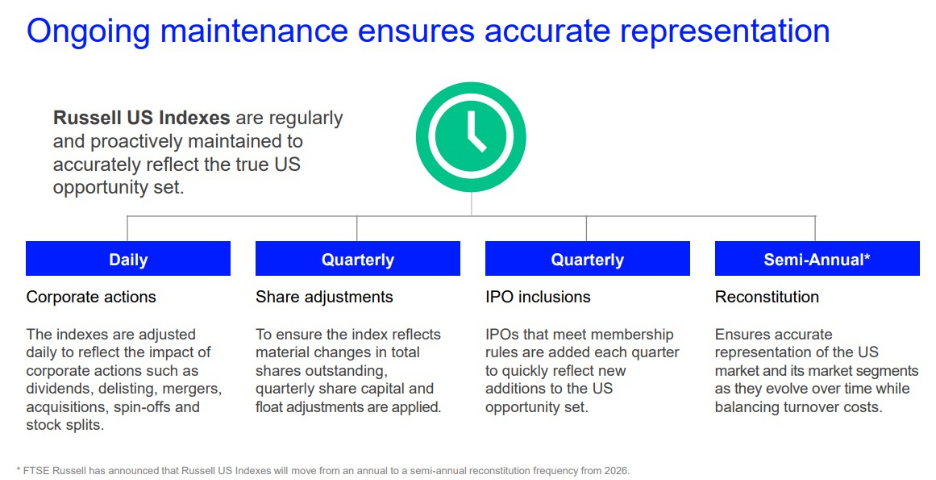
Russell US Indexes are built on a transparent, rules-based methodology, ensuring consistency and objectivity in stock inclusion. The process includes:
- Regular reconstitution (with a move from annual to semi-annual frequency starting in 2026 [Note 1])
- Quarterly IPO additions
- Clear inclusion and exclusion criteria for companies
What’s changing in 2026?
Beginning in June 2026, Russell US Indexes—including the Russell 2000—will shift from a single annual reconstitution in June to semi-annual reconstitutions in June and December. Why? Markets move faster than ever, and this change reduces turnover at the June reconstitution while improving responsiveness to market dynamics.
Why small caps, why now?
The potential investment advantages of small-cap stocks have been well documented, whether in Fama’s and French’s 1993 research paper on the “size” factor or via decades of performance data. While recent years have seen US large-cap stocks dominate returns, 2025 may have marked a turning point (see Why it’s time to revisit the Russell 2000® | LSEG). Lower interest rates and a shifting macroeconomic backdrop have renewed focus on small caps, which offer:
- Exposure to emerging companies and IPOs—potential future large-cap leaders
- Strong domestic orientation, reflecting the US economy
- Performance resilience in recoveries
In 2025, the Russell 2000 index exceeded its previous high, achieved in November 2021 during the post-COVID market recovery phase. The Russell 2000 Index price levels closed at fresh record highs above 2600 in early January 2026.
Russell 2000 Index Daily Price Levels
The Russell 2000 advantage
- Broad Representation: 2,000 small-cap US stocks, enabling full portfolio construction and style-based investing.
- Diversification: Complements large-cap exposure for balanced US equity strategies.
- Trusted Benchmark: Recognized globally, with $11.8 trillion benchmarked to Russell US Indexes and supported by a deep product ecosystem.
Looking ahead
As markets evolve, so does the Russell 2000. With semi-annual reconstitution starting in 2026, the index remains committed to transparency, relevance, and investor needs—continuing its role as the trusted benchmark for US small-cap performance.

Sources

Disclaimer
© 2025 London Stock Exchange Group plc and its applicable group undertakings (“LSEG”). LSEG includes (1) FTSE International Limited (“FTSE”), (2) Frank Russell Company (“Russell”), (3) FTSE Global Debt Capital Markets Inc. and FTSE Global Debt Capital Markets Limited (together, “FTSE Canada”), (4) FTSE Fixed Income Europe Limited (“FTSE FI Europe”), (5) FTSE Fixed Income LLC (“FTSE FI”), (6) FTSE (Beijing) Consulting Limited (“WOFE”) (7) Refinitiv Benchmark Services (UK) Limited (“RBSL”), (8) Refinitiv Limited (“RL”) and (9) Beyond Ratings S.A.S. (“BR”). All rights reserved.
FTSE Russell® is a trading name of FTSE, Russell, FTSE Canada, FTSE FI, FTSE FI Europe, WOFE, RBSL, RL, and BR. “FTSE®”, “Russell®”, “FTSE Russell®”, “FTSE4Good®”, “ICB®”, “Refinitiv” , “Beyond Ratings®”, “WMR™” , “FR™” and all other trademarks and service marks used herein (whether registered or unregistered) are trademarks and/or service marks owned or licensed by the applicable member of LSEG or their respective licensors and are owned, or used under licence, by FTSE, Russell, FTSE Canada, FTSE FI, FTSE FI Europe, WOFE, RBSL, RL or BR. FTSE International Limited is authorised and regulated by the Financial Conduct Authority as a benchmark administrator. Refinitiv Benchmark Services (UK) Limited is authorised and regulated by the Financial Conduct Authority as a benchmark administrator.
All information is provided for information purposes only. All information and data contained in this publication is obtained by LSEG, from sources believed by it to be accurate and reliable. Because of the possibility of human and mechanical inaccuracy as well as other factors, however, such information and data is provided "as is" without warranty of any kind. No member of LSEG nor their respective directors, officers, employees, partners or licensors make any claim, prediction, warranty or representation whatsoever, expressly or impliedly, either as to the accuracy, timeliness, completeness, merchantability of any information or LSEG Products, or of results to be obtained from the use of LSEG products, including but not limited to indices, rates, data and analytics, or the fitness or suitability of the LSEG products for any particular purpose to which they might be put. The user of the information assumes the entire risk of any use it may make or permit to be made of the information.
No responsibility or liability can be accepted by any member of LSEG nor their respective directors, officers, employees, partners or licensors for (a) any loss or damage in whole or in part caused by, resulting from, or relating to any inaccuracy (negligent or otherwise) or other circumstance involved in procuring, collecting, compiling, interpreting, analysing, editing, transcribing, transmitting, communicating or delivering any such information or data or from use of this document or links to this document or (b) any direct, indirect, special, consequential or incidental damages whatsoever, even if any member of LSEG is advised in advance of the possibility of such damages, resulting from the use of, or inability to use, such information.
No member of LSEG nor their respective directors, officers, employees, partners or licensors provide investment advice and nothing in this document should be taken as constituting financial or investment advice. No member of LSEG nor their respective directors, officers, employees, partners or licensors make any representation regarding the advisability of investing in any asset or whether such investment creates any legal or compliance risks for the investor. A decision to invest in any such asset should not be made in reliance on any information herein. Indices and rates cannot be invested in directly. Inclusion of an asset in an index or rate is not a recommendation to buy, sell or hold that asset nor confirmation that any particular investor may lawfully buy, sell or hold the asset or an index or rate containing the asset. The general information contained in this publication should not be acted upon without obtaining specific legal, tax, and investment advice from a licensed professional.
Past performance is no guarantee of future results. Charts and graphs are provided for illustrative purposes only. Index and/or rate returns shown may not represent the results of the actual trading of investable assets. Certain returns shown may reflect back-tested performance. All performance presented prior to the index or rate inception date is back-tested performance. Back-tested performance is not actual performance, but is hypothetical. The back-test calculations are based on the same methodology that was in effect when the index or rate was officially launched. However, back-tested data may reflect the application of the index or rate methodology with the benefit of hindsight, and the historic calculations of an index or rate may change from month to month based on revisions to the underlying economic data used in the calculation of the index or rate.
This document may contain forward-looking assessments. These are based upon a number of assumptions concerning future conditions that ultimately may prove to be inaccurate. Such forward-looking assessments are subject to risks and uncertainties and may be affected by various factors that may cause actual results to differ materially. No member of LSEG nor their licensors assume any duty to and do not undertake to update forward-looking assessments.
No part of this information may be reproduced, stored in a retrieval system or transmitted in any form or by any means, electronic, mechanical, photocopying, recording or otherwise, without prior written permission of the applicable member of LSEG. Use and distribution of LSEG data requires a licence from LSEG and/or its licensors.