

Catherine Yoshimoto
A resilient year for the FTSE All-World Index
In 2025, the FTSE All-World Index - designed to represent the performance of large- and mid-cap stocks across developed and emerging markets, covering approximately 90% of the investable equity opportunity set across nine global regions - delivered a total return of 23.1% in US dollar terms. This marked a third consecutive year of strong gains and placed 2025 among the best calendar-year performances of the past decade.
Market optimism around continued earnings growth, alongside easing inflation pressures in several major economies, were widely seen as drivers of global equity strength during 2025. Currency movements also played a role, with dollar weakness boosting the returns of non-US equities from a US investor’s perspective.
5-year performance - total return
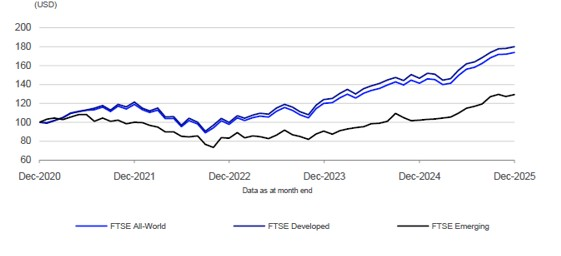
Source: FTSE Russell as at 31 December 2025. Past performance is no guarantee of future results. Returns shown before the index launch date reflect hypothetical historical performance. Please see disclaimer for important legal information.
perfomance and volatility - total return
| Index USD | Return % | Return pa % | Volatility % | ||||||||
|---|---|---|---|---|---|---|---|---|---|---|---|
| 3M | 6M | YTD | 12M | 3YR | 5YR | 3YR | 5YR | 1YR | 3YR | 5YR | |
| FTSE All-World | 3.4 | 11.4 | 23.1 | 23.1 | 77.7 | 73.9 | 21.1 | 11.7 | 13.4 | 12.0 | 13.8 |
| FTSE Developed | 3.6 | 11.2 | 22.8 | 22.8 | 80.3 | 80.0 | 21.7 | 12.5 | 14.3 | 12.2 | 14.4 |
| FTSE Emerging | 1.9 | 12.7 | 26.5 | 26.5 | 55.6 | 29.4 | 15.9 | 5.3 | 14.9 | 14.3 | 14.2 |
* Compound annual returns measured over 3 and 5 years respectively
**Volitality - 1YR based on 12 months daily data. 3YR based on weekly data (Wednesday to Wednesday). 5YR based on monthly data.
year-on-year performance - total return
| Index % (USD) | 2016 | 2017 | 2018 | 2019 | 2020 | 2021 | 2022 | 2023 | 2024 | 2025 |
| FTSE All-World | 8.6 | 24.6 | -9.1 | 27.2 | 16.6 | 18.9 | -17.7 | 22.6 | 17.7 | 23.1 |
| FTSE Developed | 8.2 | 23.9 | -8.6 | 28.0 | 16.7 | 21.4 | -17.8 | 24.2 | 18.2 | 22.8 |
| FTSE Emerging | 13.5 | 32.5 | -13.0 | 20.6 | 15.5 | 0.1 | -16.9 | 9.1 | 12.8 | 26.5 |
Source: FTSE Russell as at 31 December 2025. Past performance is no guarantee of future results. Returns shown before the index launch date reflect hypothetical historical performance. Please see disclaimer for important legal information.
Drawdowns remained constrained
The FTSE All-World Index recorded a maximum drawdown of -15.6% over the one-year period, measured on a peak-to-trough basis using daily total return data. This drawdown was shallower than the -26.0% maximum drawdown observed over the past five years, and the -33.7% maximum drawdown witnessed during the past ten years.
Mega-cap leadership still prominent
At year-end 2025, the top holdings in the FTSE All-World index reflected sustained investor interest in technology and AI-related themes as mega-cap stocks continued to dominate performance, helping drive index product development to address continuing high levels of equity market concentration.
Nvidia was the largest constituent in the FTSE All-World Index (4.6% index weight) and had the largest market cap ($4.4 trillion), followed by Apple (4.2%, $4.0 trillion) and Microsoft (3.8%, $3.6 trillion). Technology represented the largest industry exposure at 31.4% of index weight, well ahead of Financials (15.9%) and Consumer Discretionary (13.0%).
At the same time, broader index characteristics pointed to underlying breadth. At year-end 2025, the FTSE All-World Index counted 4,256 constituents, with a median constituent market cap of approximately $3.0 billion, highlighting the long tail of smaller companies that collectively contribute to diversification.
Leadership shifted from developed to emerging markets
Performance across global equities in 2025 reflected a shift in leadership between developed and emerging markets. While both segments delivered strong gains, emerging markets outperformed: the FTSE Emerging Index posted a total return of 26.5%, compared with 22.8% for the FTSE Developed Index. Emerging markets equities benefited from improving macro stability and growth expectations in several regions, along with a degree of valuation catch-up.
While results in 2025 point to a momentum shift toward emerging markets, developed markets continue to lead on a cumulative basis over the three-year period, reflecting stronger performance earlier in the cycle.
Dollar weakness helped non-US equities take the leadership baton
Benchmark index performance in 2025 also highlighted a divergence between US and non-US markets, with the FTSE All-World ex US Index recording a total return of 32.6%, well ahead of the 18.0% return delivered by the FTSE USA Index. This outperformance was helped by dollar weakness, which boosted the returns of non-US stocks for a US-based investor.
The leadership of non-US equities in 2025 represents a noteworthy shift relative to recent years. In 2024, for example, US equities handily outperformed international markets, posting a return of 25.1%, compared with 6.1% for the FTSE All-World ex US Index.
Over longer horizons, US equities still retain an advantage, however. On a three- and five-year basis, cumulative returns for the FTSE USA Index remain higher than those of the FTSE All-World ex US Index (see the chart and tables), reflecting sustained strength earlier in the post-pandemic period.
5-year performance - total return
performance and volatility - total return
| Index USD | Return % | Return pa % | Volatility % | ||||||||
|---|---|---|---|---|---|---|---|---|---|---|---|
| 3M | 6M | YTD | 12M | 3YR | 5YR | 3YR | 5YR | 1YR | 3YR | 5YR | |
| FTSE All-World Ex US Index | 5.1 | 12.6 | 32.6 | 32.6 | 63.5 | 50.6 | 17.8 | 8.5 | 13.8 | 14.1 | 13.5 |
| FTSE US Index | 2.4 | 10.7 | 18.0 | 18.0 | 87.5 | 91.9 | 23.3 | 13.9 | 18.4 | 13.2 | 15.2 |
* Compound annual returns measured over 3 and 5 years respectively
** Volatility – 1YR based on 12 months daily data. 3YR based on weekly data (Wednesday to Wednesday). 5YR based on monthly data
year-onyear performance - total return
| Index % (USD) | 2016 | 2017 | 2018 | 2019 | 2020 | 2021 | 2022 | 2023 | 2024 | 2025 |
| FTSE All-World Ex US Index | 5.1 | 27.5 | -13.9 | 22.2 | 11.5 | 8.7 | -15.2 | 16.2 | 6.1 | 32.6 |
| FTSE US Index | 11.8 | 22.1 | -4.5 | 31.6 | 20.8 | 26.8 | -19.3 | 27.1 | 25.1 | 18 |
Source: FTSE Russell as at 31 December 2025. Past performance is no guarantee of future results. Returns shown before the index launch date reflect hypothetical historical performance. Please see disclaimer for important legal information.
Structural differences between the US and non-US benchmarks remain pronounced, with index concentration levels much higher in the former: the top 10 holdings accounted for 11.7% of the FTSE All-World ex US Index at year end, versus 38.5% for the top ten stocks in the FTSE USA Index. This reflects the continuing, outsized influence of a small group of US-based technology and AI-oriented mega-cap firms on US equity performance.
Subsets of the FTSE All World Index
These differences highlight the fact that a simple subdivision of a headline benchmark can deliver very different risk and diversification outcomes. As our flagship global equity index, the FTSE All-World can be broken down into different country and regional components, as well as into developed and emerging markets, helping address investors’ asset allocation needs. For example, the following three indices, taken together, sum up to the FTSE All World Index:
- FTSE USA Index – Covers large and mid cap stocks in the US
- FTSE Developed ex US Index – Covers large and mid cap stocks in developed markets outside the US (Note: FTSE classifies South Korea as a developed market)
- FTSE Emerging Index – Covers large and mid cap stocks in emerging markets
A year of shifting leadership
Equity performance in 2025 reflected a year of shifting leadership as non-US and emerging market equities contributed more meaningfully to global performance. From an index perspective, the year underscores the value of transparent, rules-based benchmarks in helping investors analyse how market structure, concentration and regional dynamics interact to shape global equity outcomes.

Disclaimer
© 2025 London Stock Exchange Group plc and its applicable group undertakings (“LSEG”). LSEG includes (1) FTSE International Limited (“FTSE”), (2) Frank Russell Company (“Russell”), (3) FTSE Global Debt Capital Markets Inc. and FTSE Global Debt Capital Markets Limited (together, “FTSE Canada”), (4) FTSE Fixed Income Europe Limited (“FTSE FI Europe”), (5) FTSE Fixed Income LLC (“FTSE FI”), (6) FTSE (Beijing) Consulting Limited (“WOFE”) (7) Refinitiv Benchmark Services (UK) Limited (“RBSL”), (8) Refinitiv Limited (“RL”) and (9) Beyond Ratings S.A.S. (“BR”). All rights reserved.
FTSE Russell® is a trading name of FTSE, Russell, FTSE Canada, FTSE FI, FTSE FI Europe, WOFE, RBSL, RL, and BR. “FTSE®”, “Russell®”, “FTSE Russell®”, “FTSE4Good®”, “ICB®”, “Refinitiv” , “Beyond Ratings®”, “WMR™” , “FR™” and all other trademarks and service marks used herein (whether registered or unregistered) are trademarks and/or service marks owned or licensed by the applicable member of LSEG or their respective licensors and are owned, or used under licence, by FTSE, Russell, FTSE Canada, FTSE FI, FTSE FI Europe, WOFE, RBSL, RL or BR. FTSE International Limited is authorised and regulated by the Financial Conduct Authority as a benchmark administrator. Refinitiv Benchmark Services (UK) Limited is authorised and regulated by the Financial Conduct Authority as a benchmark administrator.
All information is provided for information purposes only. All information and data contained in this publication is obtained by LSEG, from sources believed by it to be accurate and reliable. Because of the possibility of human and mechanical inaccuracy as well as other factors, however, such information and data is provided "as is" without warranty of any kind. No member of LSEG nor their respective directors, officers, employees, partners or licensors make any claim, prediction, warranty or representation whatsoever, expressly or impliedly, either as to the accuracy, timeliness, completeness, merchantability of any information or LSEG Products, or of results to be obtained from the use of LSEG products, including but not limited to indices, rates, data and analytics, or the fitness or suitability of the LSEG products for any particular purpose to which they might be put. The user of the information assumes the entire risk of any use it may make or permit to be made of the information.
No responsibility or liability can be accepted by any member of LSEG nor their respective directors, officers, employees, partners or licensors for (a) any loss or damage in whole or in part caused by, resulting from, or relating to any inaccuracy (negligent or otherwise) or other circumstance involved in procuring, collecting, compiling, interpreting, analysing, editing, transcribing, transmitting, communicating or delivering any such information or data or from use of this document or links to this document or (b) any direct, indirect, special, consequential or incidental damages whatsoever, even if any member of LSEG is advised in advance of the possibility of such damages, resulting from the use of, or inability to use, such information.
No member of LSEG nor their respective directors, officers, employees, partners or licensors provide investment advice and nothing in this document should be taken as constituting financial or investment advice. No member of LSEG nor their respective directors, officers, employees, partners or licensors make any representation regarding the advisability of investing in any asset or whether such investment creates any legal or compliance risks for the investor. A decision to invest in any such asset should not be made in reliance on any information herein. Indices and rates cannot be invested in directly. Inclusion of an asset in an index or rate is not a recommendation to buy, sell or hold that asset nor confirmation that any particular investor may lawfully buy, sell or hold the asset or an index or rate containing the asset. The general information contained in this publication should not be acted upon without obtaining specific legal, tax, and investment advice from a licensed professional.
Past performance is no guarantee of future results. Charts and graphs are provided for illustrative purposes only. Index and/or rate returns shown may not represent the results of the actual trading of investable assets. Certain returns shown may reflect back-tested performance. All performance presented prior to the index or rate inception date is back-tested performance. Back-tested performance is not actual performance, but is hypothetical. The back-test calculations are based on the same methodology that was in effect when the index or rate was officially launched. However, back-tested data may reflect the application of the index or rate methodology with the benefit of hindsight, and the historic calculations of an index or rate may change from month to month based on revisions to the underlying economic data used in the calculation of the index or rate.
This document may contain forward-looking assessments. These are based upon a number of assumptions concerning future conditions that ultimately may prove to be inaccurate. Such forward-looking assessments are subject to risks and uncertainties and may be affected by various factors that may cause actual results to differ materially. No member of LSEG nor their licensors assume any duty to and do not undertake to update forward-looking assessments.
No part of this information may be reproduced, stored in a retrieval system or transmitted in any form or by any means, electronic, mechanical, photocopying, recording or otherwise, without prior written permission of the applicable member of LSEG. Use and distribution of LSEG data requires a licence from LSEG and/or its licensors.