
LISTEN TO THE PODCAST
Paul : [00:00:00] Welcome to Index Ideas from FTSE Russell. I'm Paul Amery, your podcast host. In the podcast we explore index ideas that can help you address real- world investment themes and challenges. We look into how indices are built and why. As a reminder to listeners, you can't invest in an index, and the concepts that we discuss in this podcast are not investment advice. Any reference to potential investment strategies is therefore intended for informational and educational purposes only. In this episode of the podcast, I'm joined by Stephanie Meyer, who is Global Head of Sustainable at FTSE Russell. Stephanie, welcome to Index Ideas.
Stephanie: [00:00:36] Thank you for having me. Paul.
Paul : [00:00:38] Stephanie, FTSE Russell has recently conducted its eighth annual Sustainable Investment Asset Owner survey, and we published the results in early December. Listeners can sign up on the FTSE Russell website to read a copy of the report. Why do we conduct this survey and who takes part?
Stephanie: [00:00:54] So, FTSE Russell, we work across the investment ecosystem. A very important cohort is asset owners. So, as you said, we run this global annual asset owner survey to help us better understand priorities, strategies, adoption of sustainable investment and really how that can help shape our sort of product data, index development and really better understand one of the key client groups.
Paul : [00:01:22] In January this year, 2025, the US president, Donald Trump, signed an executive order directing the US to withdraw from the Paris climate agreement. Now, some people have said that this decision really heralded the end of sustainable investing. What do the survey results say about that?
Stephanie: [00:01:40] So our survey results indicate that sustainable investment is very much alive and well. And if anything, some of these challenges around the political backdrop have actually cemented and indeed increased the focus that asset owners have on issues such as climate. So, what we've seen is that for almost three quarters of asset owners, SI is firmly embedded in what they're looking at. Climate risk as one of the sort of specific issues has increased to 85%, considering that this is an important priority for them. So, we're certainly seeing a stabilisation and perhaps a recalibration of how asset owners are approaching sustainable investment. But the importance of the underlying issues is very much alive and well.
Paul : [00:02:36] Sustainable investment saw a boom for over a decade, with an acceleration of assets flowing into sustainable funds in 2020/2021 at the outset of Covid. But since the Russia-Ukraine conflict accelerated in 2022, for many governments, energy security seems to have eclipsed net zero as a policy goal. Do you think the demand for sustainable investment has peaked?
Stephanie: [00:03:01] So energy and the energy transition continue to be a really key theme for investors broadly and the asset owners that we surveyed. As a reminder, that was over 400 global asset owners. And what we're seeing there is, yes, there is a continued focus on that low energy transition. The influence of policy has changed, but the commitment to understanding how these big themes like climate change are influencing the investment landscape continues to be very strong.
Paul : [00:03:38] Based upon the survey results, which sustainability issues are asset owners most concerned about and which are they least concerned about?
Stephanie: [00:03:45] So it's probably no surprise to hear that climate change sort of tops the list of issues that asset owners are focussed on. And both from a risk perspective, but also increasingly understanding the physical risk issues as well associated with climate change. But we're also seeing continued interest in some of the social themes like diversity and inclusion and human rights.
Paul : [00:04:11] Has the emphasis there changed over time and if so, how?
Stephanie: [00:04:15] I think we're certainly seeing the continued rise in climate risks. I think in part that's a result of what we're seeing in terms of the physical risks coming to pass. I think also to a certain extent, the change in some of that policy commitment that you referenced earlier actually means how we're going to manage those systemic risks from an investment perspective become more of a concern. So we've certainly seen those risks or concerns for those risks increase in our latest survey results.
Paul : [00:04:51] And based upon the survey results, what do they say about how investors are incorporating climate and sustainability considerations into their asset allocation?
Stephanie: [00:05:01] What we're seeing is certainly for core public equities and fixed income, there's high levels of integration. Private markets, while a key area of interest, still has a lower integration or adoption rate. We're also in our conversations with clients, seeing a lot more interest in fixed income more broadly, whether that's corporate or sovereign, as being an area that investors are increasingly looking to meaningfully incorporate sustainability considerations into their investment strategies.
Paul : [00:05:37] You talked about the growing interest in incorporating in sustainable investment in private markets and in fixed income. What about absolute levels of implementation? Can you talk about what the survey results show there?
Stephanie: [00:05:50] Yeah. So I mean absolute levels are pretty stable over the last few years. I think what we're seeing is some of the most popular or sort of common methods are a combination of ESG integration, also thematic investment. We're also seeing a lot more focus on engagement and stewardship practices as well. So asset owners really recognising both the investment decision, but importantly how those investments are being managed as well. And I think that's particularly important as we're looking to a transition that is perhaps taking a more disruptive path where there are going to be much clearer sort of winners and losers as we navigate this next decade or so.
Paul : [00:06:38] What do the survey results say about motivation: what's motivating asset owners? Is it that fear of disruption? Is it reputational risk? Is it kind of real effects on budgets and policies? You know, can we interpret any of the results in that way?
Stephanie: [00:06:52] Yeah. So we're certainly seeing financial performance and also risk management as being top drivers for what we're seeing in terms of sustainable investment practices. I think certainly that focus on the financial impact and investment impact has risen since compared to previous years. I think also, asset owners are very firmly seeing this as part of the fiduciary duty and that being a key motivator. We're also seeing an increase, I think, where we're seeing some of the shift in terms of sort of downplaying some of the impacts is societal outcomes. Asset owners are being less explicit around those being the sort of key motivators for decisions around sustainable investment.
Paul : [00:07:39] In which ways are investors currently implementing sustainable strategies? Is it through exclusions or thematic investment engagement? Tilting of index weights. What trends are you seeing there?
Stephanie: [00:07:51] Yeah. So I think as mentioned earlier the integration piece definitely continues to be key, as is thematic investment. I think thematic investment is particularly interesting if you think about some of the key sustainability trends, that can drive growth as well as risk and how those are manifesting in the investment landscape. So, I mentioned engagement continues to be really key. And certainly a number of our clients are looking at how they use engagement alongside index-based strategies as well to ensure the transparency of the construction around an index. But importantly, the engagement that's being conducted with the underlying holdings as well.
Paul : [00:08:33] How are asset owners mixing active and passive approaches in sustainable investment?
Stephanie: [00:08:37] We're seeing a hybrid approach continuing. So index-based solutions have certainly been increasing considerably. Some of the things driving that is the transparency and the clarity around those approaches. What we're seeing, though, is a continued mix of approaches over time.
Paul : [00:08:58] And how does FTSE Russell help clients in these areas, whether they're active or passive managers?
Stephanie: [00:09:03] We work closely with clients to develop custom indices, but also to support in lots of vehicles to help investment across a different range of strategies. So climate, sustainable, thematic strategies as well. One of the key partnerships we have is with the Transition Pathway Initiative, which really helps. Part of our index construction our clients assess and understand those companies that are really positioned to navigate the low-carbon transition in a much more effective way.
Paul : [00:09:36] And geopolitics aside, what are the principal barriers to the further adoption of SI?
Stephanie: [00:09:42] So we're seeing that area has certainly mixed or changed perhaps over the last couple of years. I think certainly concerns around greenwashing risk, ESG, data availability, regulatory complexity, continue to be key areas that act as carriers.
Paul : [00:10:03] And as we're recording just before Christmas 2025, I have to ask you what you're looking out for in particular in the coming year?
Stephanie: [00:10:11] Well, we will be doing a 2026 trends report, so you can look out for that later in the year. But I think we're certainly seeing climate continues to be a key theme, the energy transition that we talked about earlier continues to be a key driver of investment that we're seeing. And with that, opportunities around different technologies, for example, around nuclear as well, and linked to climate, again, the adaptation sort of concerns and nature are part of that as well. We're also seeing a really interesting shift to Asia as being a really key region in terms of both sustainable finance, but also key in terms of the real impact of climate and how what we're going to see that play out over the next year and the years to come.
Paul : [00:11:02] Thank you, Stephanie. And that's it for this episode. If you've enjoyed the conversation, then please do follow us and give us a positive rating or review on your podcast app of choice. If you'd like to get in touch with Index Ideas, you can do that via the email fmt@lseg.com but for now from me, Paul Amery, goodbye.
In the latest episode of FTSE Russell Index Ideas, Stephanie Maier, Global Head of Sustainable at FTSE Russell, explores the index’s construction, its back-tested performance characteristics and how an earnings-focused approach has historically behaved across market cycles, offering a complementary perspective on small-cap investing.
Some say global turbulence and geopolitical risks have pushed sustainable investment (SI) down investors’ list of priorities. But FTSE Russell’s latest annual survey of global asset owners suggests the opposite: sustainability concerns, and climate in particular, are still top of mind for the world’s largest investors.
415 asset owners, including private and government-linked pension funds, foundations and family offices around the world, participated in the survey. 24% of respondents looked after assets worth more than $100bn, 46% had assets between $1 and $100bn and 30% managed assets under $1bn[note1].
Stephanie Maier, Global Head of Sustainable at FTSE Russell, recently joined the FTSE Russell Index Ideas podcast to talk about the survey results.
“Our survey results indicate that SI is very much alive and well,” Maier says in the podcast.
“If anything, some of these challenges around the political backdrop have actually cemented and indeed increased the focus that asset owners have on issues such as climate.”
Maier provides figures to back up these observations.
“What we've seen is that for almost three quarters of asset owners, SI is firmly embedded in what they're looking at,” she says during the recording.
“Climate risk as one of the specific issues has increased to 85%, considering that this is an important priority for them.”
“So, we're certainly seeing a stabilisation and perhaps a recalibration of how asset owners are approaching SI. But the importance of the underlying issues is very much alive and well.”
More investors than ever say they are worried about climate risk
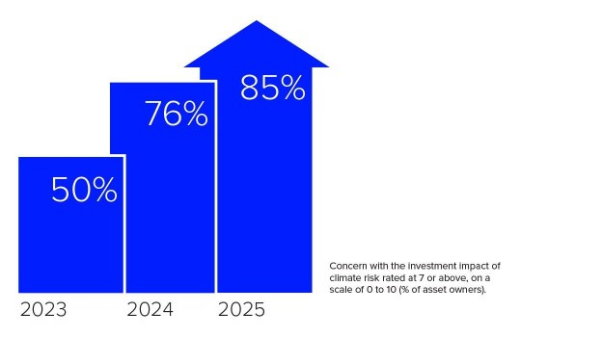
Source: FTSE Russell, 8th Annual Sustainable Investment Asset Owner Survey 2025. Past performance is not a guide to future returns. Please see the end for important legal disclosures.
In the podcast, Maier goes on to discuss the sustainability issues that asset owners currently prioritise: from the physical risks associated with climate change to social themes like diversity, inclusion and human rights.
She also talks about the extent to which asset owners build SI considerations into their asset allocation across public and private markets.
“Certainly, for core public equities and fixed income, there are higher levels of integration of SI,” Maier says.
“Private markets, while a key area of interest, still have a lower integration or adoption rate.”
“We're also seeing a lot more interest in fixed income, whether that's corporate or sovereign, as an area where investors are looking to meaningfully incorporate sustainability considerations into their investment strategies.”
Maier also discusses the motivations of asset owners when including SI as a key part of their overall strategy.
“Financial performance and risk management are top drivers for what we're seeing in terms of sustainable investment practices,” Maier says.
“That focus on the financial impact and the investment impact has risen, compared to previous years. Asset owners are very firmly seeing this as part of their fiduciary duty.”
And whereas European asset owners have in the past tended to lead the way when it comes to sustainable investment, another global region is now helping drive things forward, according to Maier.
“We're seeing a really interesting shift to Asia as being a key region in terms of sustainable finance and the real impact of climate.”
31% of the respondents to the FTSE Russell Survey came from the Asia-Pacific region, with 29% from North America and 40% from Europe, the Middle East and Africa (EMEA).
To listen to the FTSE Russell Index Ideas podcast featuring Stephanie Maier, click here.
Index Ideas by FTSE Russell is your front-row seat to the fast-changing world of indices and benchmarks.
In the podcast, we explore how FTSE Russell builds cutting-edge benchmarks to solve real-world investment challenges, helping you to manage risk and capture new opportunities. Stay ahead of market shifts and understand the ideas shaping tomorrow’s passive strategies.

Sources
[1] Including impact of reweighting (the weight of the answers of the smallest asset owners was adjusted down) | Back to Note 1
Disclaimer
© [2026] London Stock Exchange Group plc and its applicable group undertakings (“LSEG”). LSEG includes (1) FTSE International Limited (“FTSE”), (2) Frank Russell Company (“Russell”), (3) FTSE Global Debt Capital Markets Inc. “FTSE Canada”, (4) FTSE Fixed Income LLC (“FTSE FI”), (5) FTSE (Beijing) Consulting Limited (“WOFE”), FTSE EU SAS ("FTSE EU"). All rights reserved.
FTSE Russell® is a trading name of FTSE, Russell, FTSE Canada, FTSE FI, WOFE, FTSE EU and other LSEG entities providing LSEG Benchmark and Index services. “FTSE®”, “Russell®”, “FTSE Russell®”, “FTSE4Good®”, “ICB®”, “Refinitiv”, “WMR™” “FR™” and all other trademarks and service marks used herein (whether registered or unregistered) are trademarks and/or service marks owned or licensed by the applicable member of LSEG or their respective licensors.
FTSE International Limited is authorised as a Benchmark Administrator and regulated in the United Kingdom (UK) by the Financial Conduct Authority ("FCA") according to the UK Benchmark Regulation, FCA Reference Number 796803. FTSE EU SAS is authorised as Benchmark Administrator and regulated in the European Union (EU) by the Autorité des Marches Financiers (“AMF”) according to the EU Benchmark Regulation.
All information is provided for information purposes only. All information and data contained in this publication is obtained by LSEG, from sources believed by it to be accurate and reliable. Because of the possibility of human and mechanical inaccuracy as well as other factors, however, such information and data is provided "as is" without warranty of any kind. No member of LSEG nor their respective directors, officers, employees, partners or licensors make any claim, prediction, warranty or representation whatsoever, expressly or impliedly, either as to the accuracy, timeliness, completeness, merchantability of any information or LSEG Products, or of results to be obtained from the use of LSEG products, including but not limited to indices, rates, data and analytics, or the fitness or suitability of the LSEG products for any particular purpose to which they might be put. The user of the information assumes the entire risk of any use it may make or permit to be made of the information.
No responsibility or liability can be accepted by any member of LSEG nor their respective directors, officers, employees, partners or licensors for (a) any loss or damage in whole or in part caused by, resulting from, or relating to any inaccuracy (negligent or otherwise) or other circumstance involved in procuring, collecting, compiling, interpreting, analysing, editing, transcribing, transmitting, communicating or delivering any such information or data or from use of this document or links to this document or (b) any direct, indirect, special, consequential or incidental damages whatsoever, even if any member of LSEG is advised in advance of the possibility of such damages, resulting from the use of, or inability to use, such information.
No member of LSEG nor their respective directors, officers, employees, partners or licensors provide investment advice and nothing in this document should be taken as constituting financial or investment advice. No member of LSEG nor their respective directors, officers, employees, partners or licensors make any representation regarding the advisability of investing in any asset or whether such investment creates any legal or compliance risks for the investor. A decision to invest in any such asset should not be made in reliance on any information herein. Indices and rates cannot be invested in directly. Inclusion of an asset in an index or rate is not a recommendation to buy, sell or hold that asset nor confirmation that any particular investor may lawfully buy, sell or hold the asset or an index or rate containing the asset. The general information contained in this publication should not be acted upon without obtaining specific legal, tax, and investment advice from a licensed professional.
Past performance is no guarantee of future results. Charts and graphs are provided for illustrative purposes only. Index and/or rate returns shown may not represent the results of the actual trading of investable assets. Certain returns shown may reflect back-tested performance. All performance presented prior to the index or rate inception date is back-tested performance. Back-tested performance is not actual performance, but is hypothetical. The back-test calculations are based on the same methodology that was in effect when the index or rate was officially launched. However, back-tested data may reflect the application of the index or rate methodology with the benefit of hindsight, and the historic calculations of an index or rate may change from month to month based on revisions to the underlying economic data used in the calculation of the index or rate.
This document may contain forward-looking assessments. These are based upon a number of assumptions concerning future conditions that ultimately may prove to be inaccurate. Such forward-looking assessments are subject to risks and uncertainties and may be affected by various factors that may cause actual results to differ materially. No member of LSEG nor their licensors assume any duty to and do not undertake to update forward-looking assessments.
No part of this information may be reproduced, stored in a retrieval system or transmitted in any form or by any means, electronic, mechanical, photocopying, recording or otherwise, without prior written permission of the applicable member of LSEG. Use and distribution of LSEG data requires a licence from LSEG and/or its licensors.