

Alessandro Sanos, CAIA, SCR
The commodities sector stands at a crossroads. Structural shifts driven by electrification, decarbonisation and geopolitical realignment are redefining supply chains and investment priorities.
LSEG experts and industry leaders gathered in London to examine these forces and their implications for energy, shipping, metals, and carbon markets.
Energy system transformation: a slow and uneven transition
Global energy consumption continues to climb, setting new records in 2025 and projected to do so again in 2026. Whilst the share of fossil fuels in the energy mix is declining, they still account for three-quarters of global energy supply. Renewables are expanding rapidly, solar and wind have grown at 34% and 15% CAGR since 2010, but their share remains limited.
From a demand perspective, Asia has driven a remarkable 80% of global energy demand growth in the past 25 years. This exploding demand, historically from China, is now accelerating in India and Southeast Asia.
The uneven growth in energy demand and the varying pace of the transition to net zero highlight why energy security remains a strategic priority for both governments and corporates.
Electrification: demand growth meets flexibility challenges
Electrification is accelerating across transport, heating, and industry, reshaping the energy mix, commodity demand, and infrastructure needs. European power demand is forecast to grow around 2% annually through 2030, driven by EV adoption, heat pumps, hydrogen production, and the rise of AI-driven data centres. Renewables will supply a larger share—rising from 30% today to over 60% by 2035—but integration challenges persist. Negative pricing and cannibalisation are already eroding solar economics, highlighting the urgent need for storage, flexible tariffs, and grid investment.
Natural gas remains a critical balancing fuel, while metals markets face structural strain as demand for base and battery metals, including copper, lithium, cobalt, and nickel surges. Refining capacity remains highly concentrated in China, creating geopolitical and ESG risks that could impact supply security.
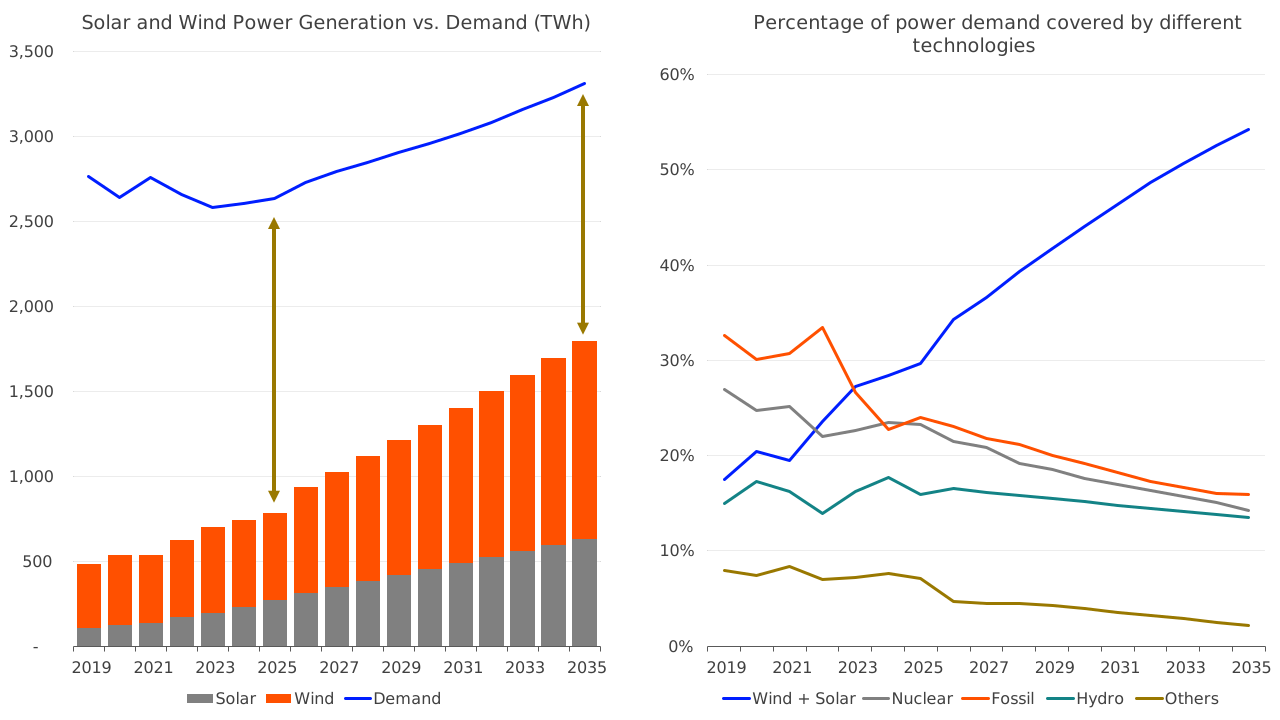
Source: LSEG. Past performance is not a guide to future returns. Please see the end for important legal disclosures.
Decarbonisation and carbon markets: incentives under scrutiny
Carbon pricing mechanisms are proliferating, yet their effectiveness varies. The EU ETS remains the benchmark, but most emission reductions have stemmed from renewables and fuel switching rather than price signals. Aviation and shipping are entering the fold, with sustainable aviation fuel (SAF) and IMO’s net-zero framework set to reshape these hard-to-abate sectors.
Compliance costs, supply chain complexity and technology innovation are already defining the next phase. Hybrid carbon market designs and rising scrutiny of offset quality under Article 6 frameworks will add further complexity.
Commodity security: climate and geopolitics intertwined
Climate change and geopolitical shocks are converging to disrupt global trade flows. Drought-induced restrictions at the Panama Canal and typhoons in Asia underscore growing climate-related vulnerabilities, while Russia’s oil exports remain resilient despite sanctions—though new measures targeting major producers could tighten supply. At the same time, tariff disputes and secondary sanctions risk fragmenting trade networks, with LNG and LPG markets being redrawn as Asia and Europe compete for cargoes. Shipping is adapting through route optimisation, fuel-saving technologies, and commercial decarbonisation. But compliance and operational risks continue to mount.
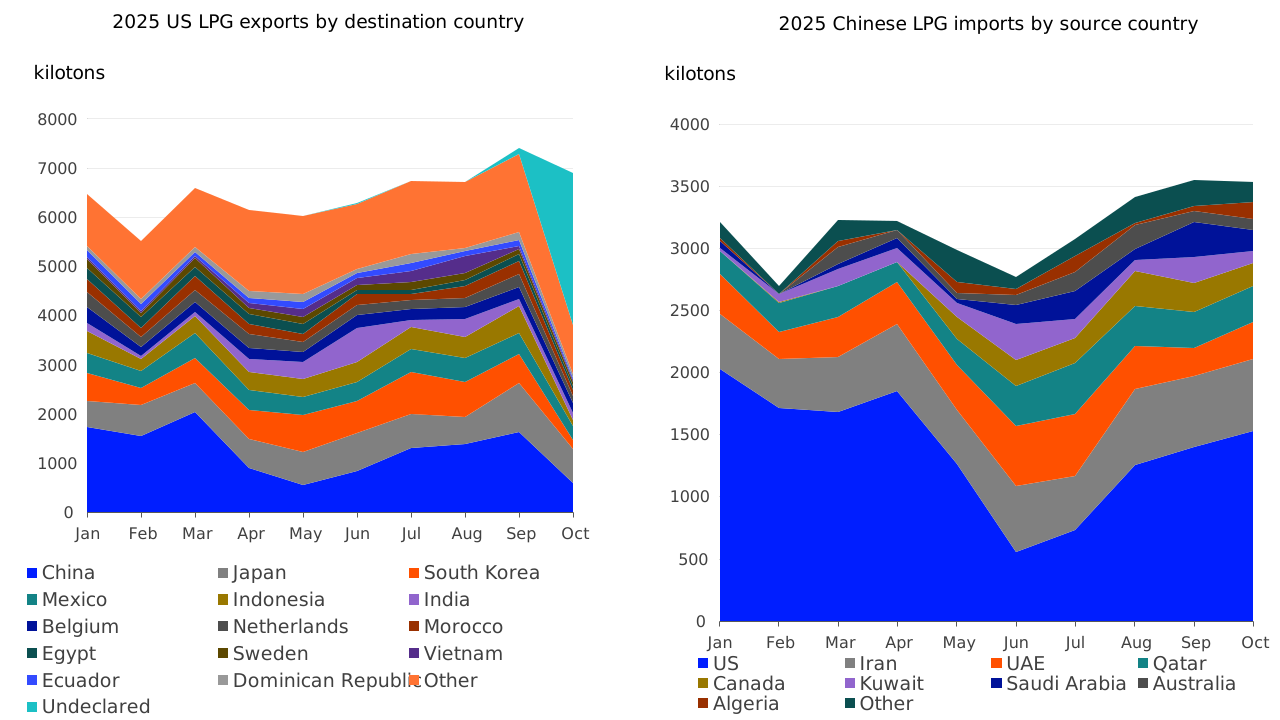
Source: LSEG. Past performance is not a guide to future returns. Please see the end for important legal disclosures.
Looking ahead: 2026 and beyond
The next 12–18 months will test the industry’s ability to adapt.
Key questions include:
- How quickly can flexibility solutions scale to support renewable integration?
- Can critical mineral supply chains diversify beyond current geographic concentrations?
- Can carbon markets deliver meaningful decarbonization incentives amid political uncertainty?
For market participants, the challenge is clear: navigate volatility while positioning for structural change.
As the path to net-zero accelerates, unevenly across sectors and geographies, the role of data you can trust to make informed decision is key.
With a Commodities Research team of 120 analysts, advanced analytics, AI ready data, and exclusive access to Reuters News, we deliver the intelligence you need to act with confidence.

Header component small Uppercase H3 -only if under H2, else use H2
Sources
[1] Sustainable investment asset owner survey 2023 | Back to Note 1
[2] Solving the Scope 3 conundrum (lseg.com) | Back to Note 2
[3] Results of the 2021 Climate Biennial Exploratory Scenario (CBES) | Bank of England | Back to Note 3
[4] Investing in the green economy 2023 - entering the next phase of growth (lseg.com) | Back to Note 4
[5] Mobilising capital for a sustainable global economy (lseg.com) | Back to Note 5
[6] IFRS - Global investor support for the launch of the IFRS Sustainability Disclosure Standards | Back to Note 6
[7] IFRS - IFRS Foundation and EFRAG publish interoperability guidance | Back to Note 7
Read more about

Legal Disclaimer
Republication or redistribution of LSEG content is prohibited without our prior written consent.
The content of this publication is for informational purposes only and has no legal effect, does not form part of any contract, does not, and does not seek to constitute advice of any nature and no reliance should be placed upon statements contained herein. Whilst reasonable efforts have been taken to ensure that the contents of this publication are accurate and reliable, LSEG does not guarantee that this document is free from errors or omissions; therefore, you may not rely upon the content of this document under any circumstances and you should seek your own independent legal, investment, tax and other advice. Neither We nor our affiliates shall be liable for any errors, inaccuracies or delays in the publication or any other content, or for any actions taken by you in reliance thereon.
Copyright © 2025 London Stock Exchange Group. All rights reserved.
The content of this publication is provided by London Stock Exchange Group plc, its applicable group undertakings and/or its affiliates or licensors (the “LSE Group” or “We”) exclusively.
Neither We nor our affiliates guarantee the accuracy of or endorse the views or opinions given by any third party content provider, advertiser, sponsor or other user. We may link to, reference, or promote websites, applications and/or services from third parties. You agree that We are not responsible for, and do not control such non-LSE Group websites, applications or services.
The content of this publication is for informational purposes only. All information and data contained in this publication is obtained by LSE Group from sources believed by it to be accurate and reliable. Because of the possibility of human and mechanical error as well as other factors, however, such information and data are provided "as is" without warranty of any kind. You understand and agree that this publication does not, and does not seek to, constitute advice of any nature. You may not rely upon the content of this document under any circumstances and should seek your own independent legal, tax or investment advice or opinion regarding the suitability, value or profitability of any particular security, portfolio or investment strategy. Neither We nor our affiliates shall be liable for any errors, inaccuracies or delays in the publication or any other content, or for any actions taken by you in reliance thereon. You expressly agree that your use of the publication and its content is at your sole risk.
To the fullest extent permitted by applicable law, LSE Group, expressly disclaims any representation or warranties, express or implied, including, without limitation, any representations or warranties of performance, merchantability, fitness for a particular purpose, accuracy, completeness, reliability and non-infringement. LSE Group, its subsidiaries, its affiliates and their respective shareholders, directors, officers employees, agents, advertisers, content providers and licensors (collectively referred to as the “LSE Group Parties”) disclaim all responsibility for any loss, liability or damage of any kind resulting from or related to access, use or the unavailability of the publication (or any part of it); and none of the LSE Group Parties will be liable (jointly or severally) to you for any direct, indirect, consequential, special, incidental, punitive or exemplary damages, howsoever arising, even if any member of the LSE Group Parties are advised in advance of the possibility of such damages or could have foreseen any such damages arising or resulting from the use of, or inability to use, the information contained in the publication. For the avoidance of doubt, the LSE Group Parties shall have no liability for any losses, claims, demands, actions, proceedings, damages, costs or expenses arising out of, or in any way connected with, the information contained in this document.
LSE Group is the owner of various intellectual property rights ("IPR”), including but not limited to, numerous trademarks that are used to identify, advertise, and promote LSE Group products, services and activities. Nothing contained herein should be construed as granting any licence or right to use any of the trademarks or any other LSE Group IPR for any purpose whatsoever without the written permission or applicable licence terms.