

Erwan Jacob
Recent escalations in the Middle East have renewed volatility in energy markets, with implications for inflation dynamics and monetary policy expectations across major economies. While headline inflation has begun to edge higher in parts of the euro area and the UK, the transmission into core inflation and policy decisions remains uncertain. In this blog, we explore how recent developments are being reflected in inflation data, market based policy expectations and investor positioning across the euro area, the UK and the United States.
Euro area inflation shows early energy driven pressures
A series of inflation data releases in the euro area pointed to a modest uptick in inflation, reflecting the impact of the conflict in the Middle East on oil and gas prices. Overall inflation in the 21 countries sharing the euro rose to 2.5% in March – up from 1.9% the previous month. Energy costs increased by 4.9%, while core inflation edged lower to 2.3% from 2.4% according to Eurostat. To date, inflationary pressures have remained largely concentrated in energy and food prices, with limited spill over into core inflation. However, higher transportation costs may place upward pressure on agricultural prices over time, reflecting increased costs from petroleum-based inputs.
UK, eurozone and US YoY CPI
Inflation data released last week also showed that Germany’s year-on-year CPI increased from 2.0% in February to 2.8% in March. Core inflation, excluding food and energy, remained unchanged at 2.5%. Services inflation, which had been elevated prior to the conflict, was unchanged at 3.2% for a third consecutive month. Risks to core inflation remain skewed to the upside, as second-round effects from higher energy costs may gradually feed through. Higher energy prices are expected to reduce Germany’s income by approximately EUR 50 billion over the year, reflecting higher spending on imported energy.
ECB policy expectations shift amid renewed inflation risks
The table below shows ECB EUR €STR OIS-based probabilities following the conflict and the ceasefire announcement:

Subsequent market pricing reflects expectations of a rate hike at the June meeting, with an additional hike priced in for September. The probability distribution table indicates a 26.85% likelihood of the ECB rate reaching 2.75%. Swap market pricing suggests that further tightening remains a possible outcome. Separately, the German Bundesbank has highlighted upside risks to inflation, with average inflation expected around 2.8% in 2026 and potentially approaching 3% in the near term, reflecting higher fuel and energy prices.
UK inflation exposure and evolving Bank of England expectations
Among G7 economies, the UK appears relatively exposed – given that around 25% of electricity generation depends on natural gas. The UK has also recorded year-on-year inflation of around 3% in recent months. At the same time, market expectations for Bank of England policy have shifted, moving away from previously anticipated rate cuts earlier in the year.
Bank of England Governor Andrew Bailey noted last week that markets may have been “getting ahead of themselves”. He acknowledged that some pass-through of higher energy costs by firms is likely, while also highlighting ongoing economic weakness. This contrasts with developments in 2022, when energy prices rose sharply following Russia’s invasion of Ukraine. Business sentiment in the UK remains subdued, which may limit companies’ ability to raise prices. However, the Food and Drink Federation (FDF) has indicated that food and non-alcoholic drink inflation – previously expected to ease to 3.2% by December 2026 – could rise above 9% under current assumptions.
The table below indicates BoE SONIA OIS-based probabilities following the conflict and the ceasefire announcement:
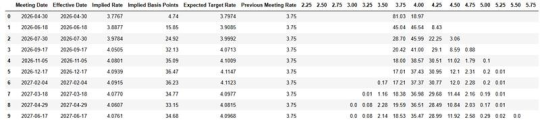
Despite an earlier repricing away from rate cuts following the escalation, subsequent market moves after the ceasefire announcement now imply that a rate cut is priced for June, with a further cut expected in September. The Bank Rate is projected to reach 4.25% by the end of the year. Higher interest rates are expected to weigh on household consumption and the government budget deficit, particularly as unemployment has been rising. Headline inflation is expected to increase in the second half of the year and may peak at 3.6% in September 2026, reflecting higher wholesale energy prices.
US outlook remains more insulated despite global uncertainty
The table below demonstrates Fed funds futures-based probabilities following the conflict and the ceasefire announcement:
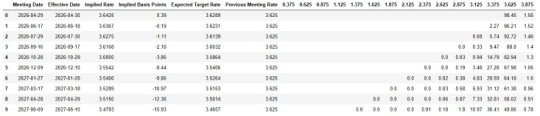
In the US, market expectations continue to imply a Federal Reserve rate cut, although only one cut is currently priced in for June next year. Compared with the UK and euro area, recent developments appear to have had a more limited impact on US monetary policy expectations. A further consideration is the forthcoming appointment of a new Federal Reserve Chair, which may influence policy expectations over time. Stagflation risks remain comparatively lower, with US economic growth in 2026 expected to exceed 2%, outperforming projected growth in the UK and euro area.
US GDP growth continues to be supported by capital expenditure in technology-related sectors. A firmer US dollar may help moderate imported inflation pressures, while lower reliance on imported gas and oil provides additional insulation. However, historical patterns suggest that Fed funds futures may at times misprice the future policy path, which can result in market dislocations.
Market implications and investor positioning
Overall, economic outcomes will depend on the duration and evolution of the conflict. Central banks may face a more complex policy environment should inflation begin to feed through more persistently into core measures. Growth in both the UK and Germany is expected to remain subdued. In this context, investors have shown a preference for perceived safe-haven assets such as CHF and USD, alongside money market instruments and cash. A stronger US dollar could contribute to imported inflation, particularly for economies reliant on energy imports. Countries with a high dependence on gas for electricity generation, including the UK, Italy, the Netherlands and Japan, remain among the more exposed.

Read more about

Legal Disclaimer
Republication or redistribution of LSEG content is prohibited without our prior written consent.
The content of this publication is for informational purposes only and has no legal effect, does not form part of any contract, does not, and does not seek to constitute advice of any nature and no reliance should be placed upon statements contained herein. Whilst reasonable efforts have been taken to ensure that the contents of this publication are accurate and reliable, LSEG does not guarantee that this document is free from errors or omissions; therefore, you may not rely upon the content of this document under any circumstances and you should seek your own independent legal, investment, tax and other advice. Neither We nor our affiliates shall be liable for any errors, inaccuracies or delays in the publication or any other content, or for any actions taken by you in reliance thereon.
Copyright © 2025 London Stock Exchange Group. All rights reserved.
The content of this publication is provided by London Stock Exchange Group plc, its applicable group undertakings and/or its affiliates or licensors (the “LSE Group” or “We”) exclusively.
Neither We nor our affiliates guarantee the accuracy of or endorse the views or opinions given by any third party content provider, advertiser, sponsor or other user. We may link to, reference, or promote websites, applications and/or services from third parties. You agree that We are not responsible for, and do not control such non-LSE Group websites, applications or services.
The content of this publication is for informational purposes only. All information and data contained in this publication is obtained by LSE Group from sources believed by it to be accurate and reliable. Because of the possibility of human and mechanical error as well as other factors, however, such information and data are provided "as is" without warranty of any kind. You understand and agree that this publication does not, and does not seek to, constitute advice of any nature. You may not rely upon the content of this document under any circumstances and should seek your own independent legal, tax or investment advice or opinion regarding the suitability, value or profitability of any particular security, portfolio or investment strategy. Neither We nor our affiliates shall be liable for any errors, inaccuracies or delays in the publication or any other content, or for any actions taken by you in reliance thereon. You expressly agree that your use of the publication and its content is at your sole risk.
To the fullest extent permitted by applicable law, LSE Group, expressly disclaims any representation or warranties, express or implied, including, without limitation, any representations or warranties of performance, merchantability, fitness for a particular purpose, accuracy, completeness, reliability and non-infringement. LSE Group, its subsidiaries, its affiliates and their respective shareholders, directors, officers employees, agents, advertisers, content providers and licensors (collectively referred to as the “LSE Group Parties”) disclaim all responsibility for any loss, liability or damage of any kind resulting from or related to access, use or the unavailability of the publication (or any part of it); and none of the LSE Group Parties will be liable (jointly or severally) to you for any direct, indirect, consequential, special, incidental, punitive or exemplary damages, howsoever arising, even if any member of the LSE Group Parties are advised in advance of the possibility of such damages or could have foreseen any such damages arising or resulting from the use of, or inability to use, the information contained in the publication. For the avoidance of doubt, the LSE Group Parties shall have no liability for any losses, claims, demands, actions, proceedings, damages, costs or expenses arising out of, or in any way connected with, the information contained in this document.
LSE Group is the owner of various intellectual property rights ("IPR”), including but not limited to, numerous trademarks that are used to identify, advertise, and promote LSE Group products, services and activities. Nothing contained herein should be construed as granting any licence or right to use any of the trademarks or any other LSE Group IPR for any purpose whatsoever without the written permission or applicable licence terms.