

Tajinder Dhillon

Luke Lu

Plamen Mitkov

Miles Li

Detlef Glow

Robin Marshall

Irene Shi

Hank Qian

Dewi John

Jharonne Martis

Loy Weng
The first half of 2026 tested markets with geopolitical tensions, an energy shock and persistent inflation concerns. Yet investors have largely remained focused on growth opportunities, particularly those linked to artificial intelligence. In this mid-year outlook, LSEG experts examine the trends shaping macroeconomics, equities, retail, funds and structured finance as investors prepare for the months ahead.
Key takeaways
- The 2026 oil shock looks very different from 2022
Despite a major disruption in energy markets, inflation expectations and financial conditions have remained relatively contained compared with the post-pandemic and Ukraine-driven shocks.
- AI continues to drive market leadership
Strong earnings growth, record margins and sustained investment in AI infrastructure are supporting equity markets and investor sentiment.
- Selectivity matters
From consumers seeking value to investors navigating credit and housing markets, the second half of 2026 is likely to reward disciplined decision-making over broad market exposure.
Section One
A resilient global economy faces a new energy shock
The year began with markets confronting what the International Energy Agency described as one of the largest oil supply disruptions on record. Yet the economic backdrop is very different from the inflationary environment that followed Russia’s invasion of Ukraine in 2022.
Lower inflation, softer demand growth and greater flexibility across global energy supply chains have helped limit the economic fallout. While government bond yields remain elevated, financial conditions in major economies are still close to long-term averages.
The defining feature of 2026 is not the oil shock itself, but the market’s ability to absorb it.
Exhibit 1: FTSE Russell Financial Conditions indicators (stand.dev.from long term mean)
Section two
AI investment continues to power equity markets
US large-cap equities remain near record highs after one of the strongest earnings seasons in recent decades.
Technology companies continue to account for a disproportionate share of earnings growth, but market leadership is gradually broadening beyond the Magnificent Seven. At the same time, investors are asking whether billions of dollars in AI infrastructure spending can generate sustainable long-term returns.
Key insight
2026 may represent peak growth in AI capital expenditure — not necessarily peak spending.
Companies including Meta, Alphabet and Microsoft continue to generate returns above their cost of capital, suggesting the current AI investment cycle remains economically justified.
Exhibit 14: Aggregate Capital Expenditures – Actuals and StarMine Forecasts
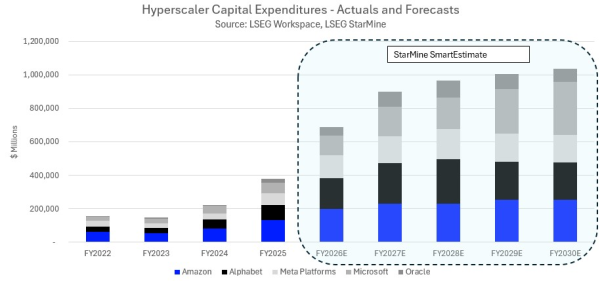
Source: LSEG Workspace, LSEG StarMine. Past performance is not a guide to future returns. Please see the end for important legal disclosures.
Section three
The consumer is evolving, not retreating
Retail earnings delivered a strong start to the year, supported by solid employment conditions and resilient consumer spending.
However, beneath the headline figures, spending behaviour is becoming increasingly fragmented.
- Higher-income consumers continue to support premium brands.
- Middle-income consumers are becoming more selective.
- Value-conscious shoppers are gravitating toward discount and off-price retailers.
Retailers with strong brands, pricing power and disciplined inventory management are likely to be best positioned for the second half of the year.
Exhibit 23: The LSEG Retail Index Sectors: Q1 2026 Act – Q4 2026 Est.
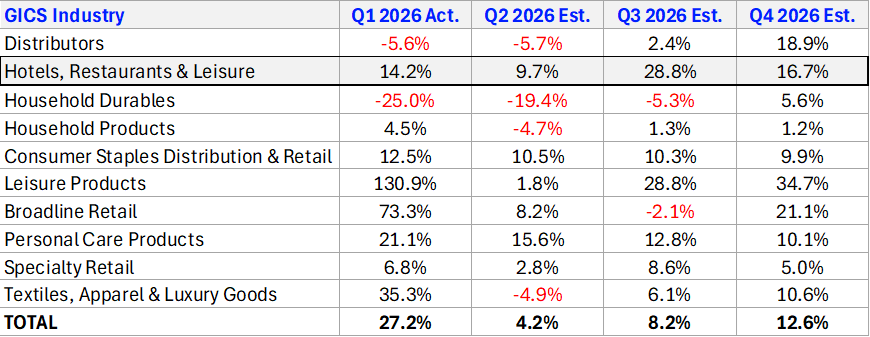
Source: LSEG I/B/E/S. Past performance is not a guide to future returns. Please see the end for important legal disclosures.
Section four
Investor optimism is overcoming geopolitical concerns
Fund flow trends suggest investors continue to prioritise growth opportunities despite heightened geopolitical uncertainty.
In particular, enthusiasm surrounding artificial intelligence has continued to attract capital into US equities and technology funds.
While global investors have followed different allocation paths, confidence in AI-driven growth increasingly appears capable of offsetting concerns around tariffs, conflict and economic uncertainty.
AI may be influencing investment decisions more than geopolitics in 2026.
Exhibit 37: Equity Global, Global ex-US, Information Technology and US: US domicile ($bn)
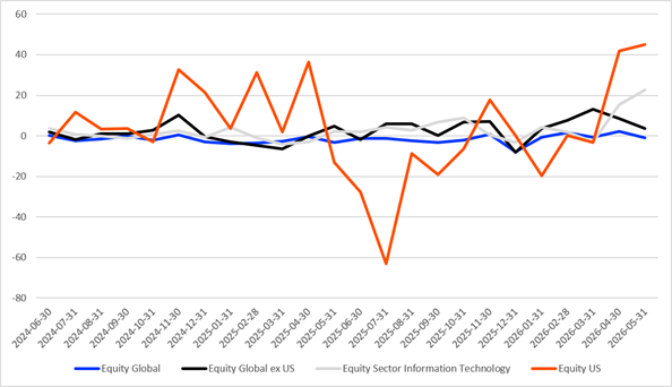
Source: LSEG Lipper. June 2024-May 2026. Past performance is not a guide to future returns. Please see the end for important legal disclosures.
Section five
Housing and mortgage markets show signs of stabilisation
Activity across housing and mortgage-backed securities markets has remained resilient.
Improving inventories, stable issuance and modest house price appreciation are contributing to a gradual normalisation of housing market conditions.
Key themes include:
- Increasing housing inventory
- Stable mortgage rates
- Recovery in agency issuance
- Moderate home price growth
Affordability remains a challenge, but the broader housing market appears more balanced than it has been in recent years.
Exhibit 46: Projected Prepayment under Different Rate Scenario (% of Mortgage Paying Off in 1 Year)
| Rate Change | FNM Refinance | FNM Home Sale | GNII Refinance | GNII Home Sale |
|---|---|---|---|---|
| -3.00% | 22.27% | 4.59% | 39.66% | 5.11% |
| -2.00% | 17.23% | 4.50% | 29.68% | 5.03% |
| -1.00% | 8.93% | 4.40% | 17.07% | 4.94% |
| Current | 2.41% | 4.20% | 3.63% | 4.77% |
| 1.00% | 1.05% | 3.81% | 1.34% | 4.29% |
| 2.00% | 0.70% | 3.30% | 1.10% | 3.61% |
| 3.00% | 0.56% | 2.84% | 0.98% | 3.02% |
Source: LSEG Yield Book. Past performance is not a guide to future returns. Please see the end for important legal disclosures.
Section six
Credit markets remain constructive, but risks are emerging
Across non-agency RMBS, CMBS and CLO markets, issuance has remained robust despite continued macroeconomic uncertainty.
Investors continue to favour securitised credit markets, supported by relatively stable credit performance and strong demand.
Key risks include:
- Higher-for-longer interest rates
- Refinancing pressure
- Credit dispersion
- Sector-specific stress, particularly within software-related lending
While the outlook remains constructive, market participants are paying closer attention to collateral quality and issuer discipline.
Exhibit 50: Mortgage rates trend
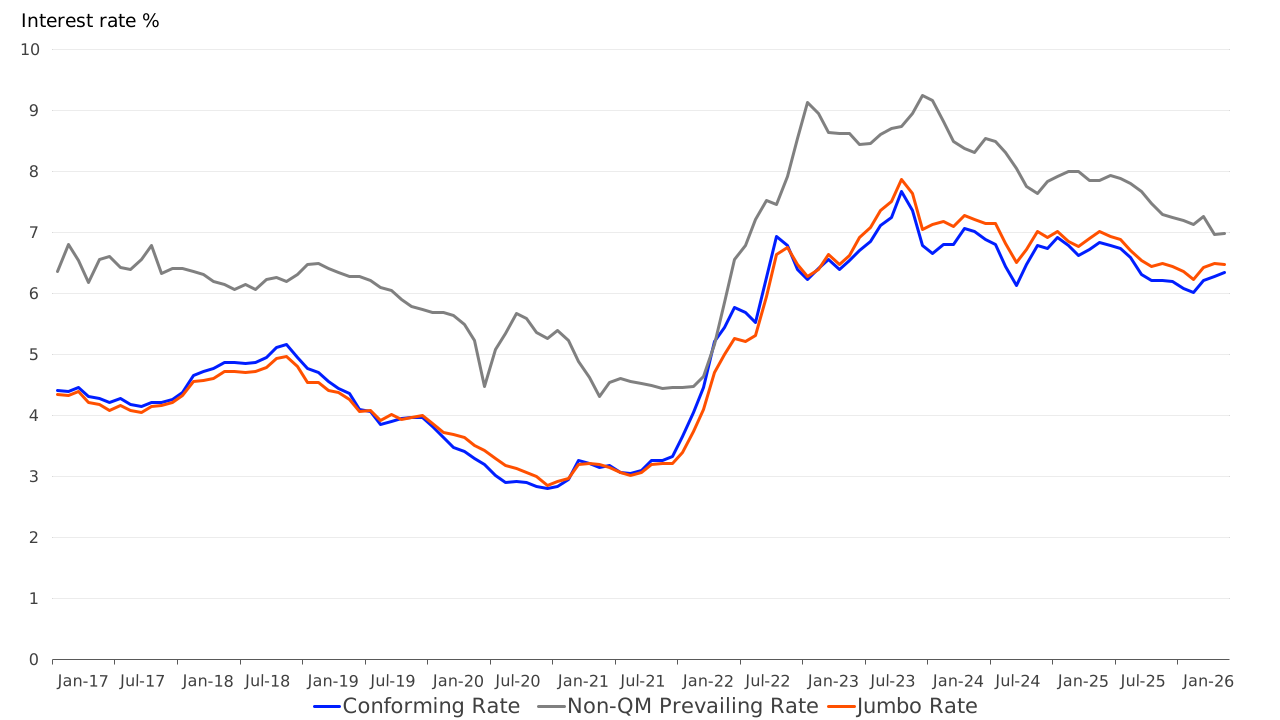
Source: LSEG Yield Book, Optimal Blue. Past performance is not a guide to future returns. Please see the end for important legal disclosures.
Section seven
Fixed income enters a new phase of opportunity
After years dominated by inflation concerns and rate uncertainty, fixed income markets are entering a more balanced environment. Investors are increasingly shifting their focus from macroeconomic speculation to fundamentals, income generation and security selection.
Higher yields continue to offer attractive opportunities across government, investment-grade and select credit markets, while easing inflation pressures have improved visibility around future monetary policy.
However, opportunities are unlikely to be evenly distributed. Credit quality, duration exposure and sector allocation will become increasingly important as investors navigate a market where returns are expected to be driven more by fundamentals than central bank intervention.
Key insight
Higher yields have restored fixed income as both an income source and a portfolio diversifier.
What to watch
- Central bank policy signals
- Inflation trends across major economies
- Credit quality and default activity
- Investor appetite for duration risk
Exhibit 72: Agency CMBS Gross Loan Issuance by Year
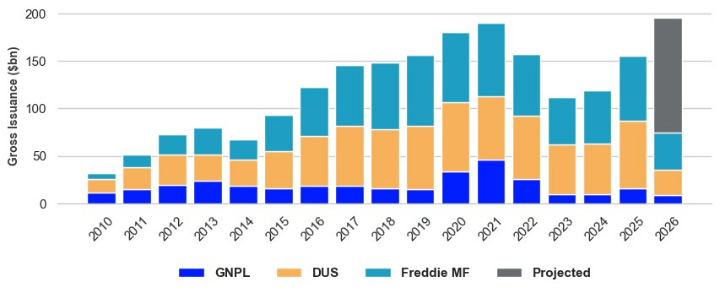
Source: GNMA, FNMA, FLHMC, LSEG Yield Book (June 2026). Past performance is not a guide to future returns. Please see the end for important legal disclosures.
Section eight
Navigating uncertainty in a world of structural change
While 2026 has been defined by resilience, the second half of the year will be shaped by the interaction of several long-term forces: artificial intelligence, energy security, shifting consumer behaviour, geopolitical fragmentation and evolving capital markets.
The common thread across every asset class is adaptation. Organisations, investors and policymakers are adjusting to a market environment where uncertainty remains elevated, but opportunities continue to emerge.
Rather than signalling a return to pre-pandemic norms, current market conditions suggest the emergence of a new operating environment—one where technology-led productivity gains, selective risk-taking and disciplined capital allocation are likely to define success.
Key insight
The most important trend of 2026 may not be resilience itself, but the ability to adapt to constant change.
Looking ahead
As investors position for the remainder of the year, several themes will remain in focus:
- The long-term impact of AI investment
- Energy security and commodity market volatility
- The path of inflation and interest rates
- Consumer spending resilience
- Housing market stability
- Credit market fundamentals
Exhibit 89: 2025-2026 CLO issuance (New Issuance and Refinance/Reset/Reissue)
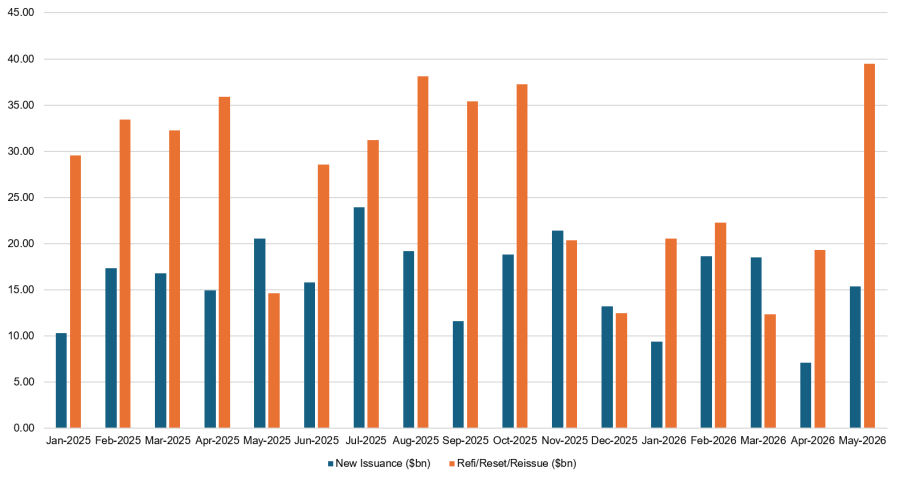
Source: Green Street, Yield Book (June 2026). Past performance is not a guide to future returns. Please see the end for important legal disclosures.
Conclusion
What to watch in the second half of 2026
The dominant theme of 2026 so far is resilience.
Markets have absorbed geopolitical shocks, inflation concerns and elevated rates while continuing to focus on long-term growth opportunities. The expansion of artificial intelligence investment remains a critical driver of corporate earnings and investor sentiment, while housing and credit markets have shown notable durability.
The months ahead will help determine whether these trends can be sustained. For investors, the focus is shifting away from broad market direction and towards identifying where resilience, earnings growth and strong fundamentals remain most durable.

Read more about

Legal Disclaimer
Republication or redistribution of LSE Group content is prohibited without our prior written consent.
The content of this publication is for informational purposes only and has no legal effect, does not form part of any contract, does not, and does not seek to constitute advice of any nature and no reliance should be placed upon statements contained herein. Whilst reasonable efforts have been taken to ensure that the contents of this publication are accurate and reliable, LSE Group does not guarantee that this document is free from errors or omissions; therefore, you may not rely upon the content of this document under any circumstances and you should seek your own independent legal, investment, tax and other advice. Neither We nor our affiliates shall be liable for any errors, inaccuracies or delays in the publication or any other content, or for any actions taken by you in reliance thereon.
Copyright © 2026 London Stock Exchange Group. All rights reserved.
The content of this publication is provided by London Stock Exchange Group plc, its applicable group undertakings and/or its affiliates or licensors (the “LSE Group” or “We”) exclusively.
Neither We nor our affiliates guarantee the accuracy of or endorse the views or opinions given by any third party content provider, advertiser, sponsor or other user. We may link to, reference, or promote websites, applications and/or services from third parties. You agree that We are not responsible for, and do not control such non-LSE Group websites, applications or services.
The content of this publication is for informational purposes only. All information and data contained in this publication is obtained by LSE Group from sources believed by it to be accurate and reliable. Because of the possibility of human and mechanical error as well as other factors, however, such information and data are provided "as is" without warranty of any kind. You understand and agree that this publication does not, and does not seek to, constitute advice of any nature. You may not rely upon the content of this document under any circumstances and should seek your own independent legal, tax or investment advice or opinion regarding the suitability, value or profitability of any particular security, portfolio or investment strategy. Neither We nor our affiliates shall be liable for any errors, inaccuracies or delays in the publication or any other content, or for any actions taken by you in reliance thereon. You expressly agree that your use of the publication and its content is at your sole risk.
To the fullest extent permitted by applicable law, LSE Group, expressly disclaims any representation or warranties, express or implied, including, without limitation, any representations or warranties of performance, merchantability, fitness for a particular purpose, accuracy, completeness, reliability and non-infringement. LSE Group, its subsidiaries, its affiliates and their respective shareholders, directors, officers employees, agents, advertisers, content providers and licensors (collectively referred to as the “LSE Group Parties”) disclaim all responsibility for any loss, liability or damage of any kind resulting from or related to access, use or the unavailability of the publication (or any part of it); and none of the LSE Group Parties will be liable (jointly or severally) to you for any direct, indirect, consequential, special, incidental, punitive or exemplary damages, howsoever arising, even if any member of the LSE Group Parties are advised in advance of the possibility of such damages or could have foreseen any such damages arising or resulting from the use of, or inability to use, the information contained in the publication. For the avoidance of doubt, the LSE Group Parties shall have no liability for any losses, claims, demands, actions, proceedings, damages, costs or expenses arising out of, or in any way connected with, the information contained in this document.
LSE Group is the owner of various intellectual property rights ("IPR”), including but not limited to, numerous trademarks that are used to identify, advertise, and promote LSE Group products, services and activities. Nothing contained herein should be construed as granting any licence or right to use any of the trademarks or any other LSE Group IPR for any purpose whatsoever without the written permission or applicable licence terms.