
Profile
Objectives
Amundi was seeking a set of indices to provide investors with a diversified, multi-asset portfolio tailored to specific future target dates, as well as embedding selected ESG criteria.
Solution
The FTSE Lifecycle Screened Select Index Series measures the total return of a universe of securities whose asset class weights are adjusted over time based on a “glidepath”.
Client profile
Amundi is the leading European asset manager, ranking among the top 10 global players. It offers its 100 million clients – retail, institutional and corporate – a complete range of savings and investment solutions in active and passive management, in traditional or real assets. This offering is enhanced with IT tools and services to cover the entire savings value chain. A subsidiary of the Crédit Agricole group and listed on the Euronext stock exchange, Amundi managed around €2.3 trillion of assets in June 2025.
With its six international investment hubs, financial and extra-financial research capabilities and long-standing commitment to responsible investment, Amundi is a key player in the asset management landscape. As at June 2025, the firm had 5,500 employees in 35 countries.
Developing target date funds in Europe
Target Date Funds (TDFs) were first launched in the mid-1990s in the US.
They are collective investment schemes that aim to support individual retirement goals. TDFs do this by adjusting their asset allocation according to a specified target date, which is typically aligned with an investor's retirement date. This is commonly referred to as following an asset allocation “glidepath”.
TDFs provide a diversified portfolio that gradually becomes more conservative as the target date approaches, providing an increasing degree of protection against market volatility over time.
Amundi wished to appoint a benchmark provider to create a set of target date/lifecycle indices that would underlie its planned target date exchange-traded funds (ETFs), aimed at a European client base. The indices within the series should embed the following characteristics:
- The indices should cover multiple asset classes—such as equities, government bonds, corporate bonds, green bonds and cash equivalents—to provide diversification benefits;
- They should align with a set of target retirement dates, with the indices at nearer target retirement dates following a more conservative asset allocation;
- They should have a mechanism to rebalance automatically over time;
- The principal base indices should consider ESG factors in their construction methodology.
Sample asset allocation glidepath with underlying FTSE Russell indices (“T”=retirement date in years)
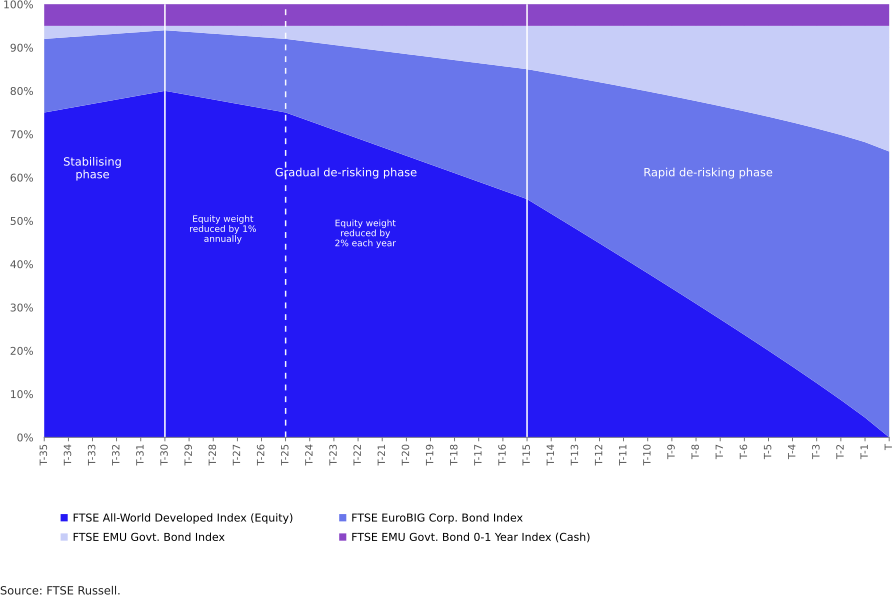
| Phase | Time Period | Equity Allocation (FTSE All-World Developed Index) | Corporate Bonds (FTSE EuroBIG Corp. Bond Index) | Government Bonds (FTSE EMU Govt. Bond Index) | Cash (FTSE EMU Govt. Bond 0-1 Year Index) |
|---|---|---|---|---|---|
| Stabilising phase | T-35 to T-30 | Increases from approximately 75% to 80% | Decreases slightly from approximately 17% to 14% | Remains around 8% to 10% | Approximately 5% |
| Gradual de-risking phase | T-30 to T-15 | Reduced gradually from approximately 80% to 55% | Increases from approximately 14% to 30% | Increases from approximately 6% to 10% | Approximately 5% |
| Rapid de-risking phase | T-15 to Target Date (T) | Reduced rapidly from approximately 55% to 0% | Increases substantially from approximately 30% to 66% | Increases to approximately 29% | Approximately 5% |
| Target Date (T) | T | 0% | Approximately 66% | Approximately 29% | Approximately 5% |
The FTSE lifecycle screened select Index Series
The FTSE Lifecycle Screened Select index series measures the total return of a multi-asset universe of securities where the weight of eligible asset classes is adjusted over time based on a “Glidepath”, which reduces equity exposure and increases fixed income exposure, until a future “Target Date”.
The index series takes account of Environmental, Social and Governance (ESG) factors in its index design. During the lifecycle, a majority of the weights are allocated to reference indices which use ESG data.
The underlying asset class universes are global equity securities, corporate bonds, government bonds and shortterm instruments.
In February 2025, Amundi announced that it had selected FTSE Russell’s FTSE Lifecycle Screened Select Index Series as the underlying reference benchmark for four new Amundi UCITS ETFs.
The FTSE Lifecycle Screened Select Index Series is comprised of eligible global equity securities, which are generally viewed as exhibiting a higher risk profile, and EUR-denominated fixed income securities, which are generally viewed as exhibiting a lower risk profile. Each asset class is represented by a standard FTSE Russell index (“Base Universe”).
The Base Universes in the FTSE Lifecycle Screened Select Index Series are:
- FTSE Developed Screened Select Index;
- FTSE Euro Broad Investment-Grade Screened Select Corporate Bond Index;
- FTSE EMU Government Bond Select Index;
- FTSE EMU Green Government Bond Select Index;
- FTSE EMU Government Bond 0-1 Years Select Index.
These indices embed selected ESG factors. For example, the FTSE Developed Screened Select Index measures the performance of companies that meet specified index inclusion criteria, incorporating FTSE ESG scores, product involvement and conduct-related data.
The four target-date indices created as part of this index series are shown in the table.
| Index | Base date | Target date (T) |
|---|---|---|
| FTSE Lifecycle 2030 Screened Select Index | 31 December 2017 | 30 November 2030 |
| FTSE Lifecycle 2033 Screened Select Index | 31 December 2017 | 30 November 2033 |
| FTSE Lifecycle 2036 Screened Select Index | 31 December 2017 | 30 November 2036 |
| FTSE Lifecycle 2039 Screened Select Index | 31 December 2017 | 30 November 2039 |
Helping index users meet retirement goals
The FTSE Lifecycle Screened Select Index Series is a suite of indices designed to support retirement investing, combining strategic asset allocation with ESG integration and a post-retirement glidepath. These indices are built using established FTSE Russell indices as building blocks and incorporate ESG criteria, making them suitable for investors interested in sustainable finance.
Sources
[1] IPE “Top 500 Asset Managers” published in June 2025, based on assets under management as at 31/12/2024 | Back to Note 1
[2] Amundi, as at 30/6/25 | Back to Note 2