To listen to the FTSE Russell Index Ideas episode with Catherine Yoshimoto
An index like the Russell 3000, the FTSE All-Share or the FTSE Global All Cap enables us to view the stock market..
But sometimes we want to segment the equity market into building blocks, using attributes like company size or style.
In fact, viewing the US stock market through a style lens has long been a popular approach among asset managers.
The Russell Style Indexes (growth and value) were introduced in 1987, three years after the launch of the Russell 1000, 2000 and 3000.
The Style Indexes helped meet the need of active asset managers who preferred to measure their performance of particular cohorts of US equities.
FTSE Russell added a third dimension of style—dynamic versus defensive stocks—to the index range in 2011.
But how do we define “growth” and “value”, or “dynamic” and “defensive”? Is there a hard dividing line between the two categories or are they less rigid? How do we build an index once we’ve worked out the style scores?
In the November 2025 episode of FTSE Russell Index Ideas podcast, Catherine Yoshimoto, director of product management at FTSE Russell, answers these questions and more.
In the podcast, she explains the construction principles behind the Russell Style Indexes, which are the most widely used type of benchmark in the whole Russell US Indexes family.
The Russell Style indexes have approximately $7.5trn benchmarked, including both active and passive assets, relative to the total for the entire Russell US Indexes, which is almost $12trn. So it's almost two-thirds of the entire Russell assets benchmarked,
Catherine Yoshimoto
She goes on to explain how FTSE Russell defines the growth and value styles for use in the Russell Style indexes.
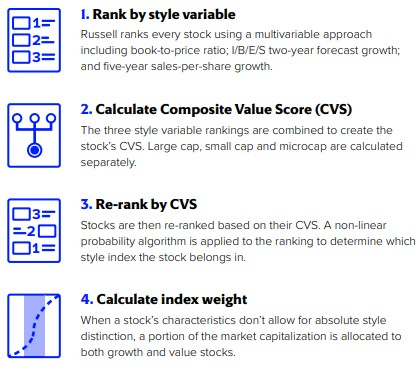
“The book-to-price ratio is used for the value portion, and there is a scoring process that combines this value metric with the two-growth metrics—the forecast medium term [earnings] growth and historical five-year sales-per-share growth,” she says.
“So it's a combination of three highly representative variables, one value and two-growth, that is combined to create a composite value score. That translates into how the overall index market cap is divided between the growth and value indexes.”
There is no sharp division between the two equity styles, however, Yoshimoto says, taking the Russell 1000 index of US large-cap stocks as an example.
“There are about 30% [of stocks] in the middle that are in both the growth and value indexes,” she says.
For these companies, FTSE Russell apportions part of the market capitalisation to each style index.
“There's no double-counting, in the sense that the shares and market cap roll up into the Russell 1000,” Yoshimoto says.
“But some companies in the middle that aren't distinctly growth or value are in both indexes.”
Russell Style Indexes methodology
What about the magnificent seven (Mag 7) stocks that have dominated US equity market performance for the last few years? Surely they all fall into the growth category?
“They were until this year's Russell Indexes reconstitution (in June 2025),” Yoshimoto explains during the podcast.
“But because of their movement in book-to-price relative to the rest of the index, or in one of the other growth metrics for one of the companies, three of the Mag 7 companies—Alphabet, Amazon and Meta—are now partially growth and value,” she says.
In the podcast, Yoshimoto goes on to explain how FTSE Russell has introduced new, capped versions of the Russell Style Indexes to address the challenge of increasing index concentration in a few large companies.
She explains how and when the Russell Style Indexes are kept up to date and what will happen when the Russell US Indexes add a second semi-annual reconstitution date in 2026.

Read more about

Disclaimer
© 2025 London Stock Exchange Group plc and its applicable group undertakings (“LSEG”). LSEG includes (1) FTSE International Limited (“FTSE”), (2) Frank Russell Company (“Russell”), (3) FTSE Global Debt Capital Markets Inc. and FTSE Global Debt Capital Markets Limited (together, “FTSE Canada”), (4) FTSE Fixed Income Europe Limited (“FTSE FI Europe”), (5) FTSE Fixed Income LLC (“FTSE FI”), (6) FTSE (Beijing) Consulting Limited (“WOFE”) (7) Refinitiv Benchmark Services (UK) Limited (“RBSL”), (8) Refinitiv Limited (“RL”) and (9) Beyond Ratings S.A.S. (“BR”). All rights reserved.
FTSE Russell® is a trading name of FTSE, Russell, FTSE Canada, FTSE FI, FTSE FI Europe, WOFE, RBSL, RL, and BR. “FTSE®”, “Russell®”, “FTSE Russell®”, “FTSE4Good®”, “ICB®”, “Refinitiv” , “Beyond Ratings®”, “WMR™” , “FR™” and all other trademarks and service marks used herein (whether registered or unregistered) are trademarks and/or service marks owned or licensed by the applicable member of LSEG or their respective licensors and are owned, or used under licence, by FTSE, Russell, FTSE Canada, FTSE FI, FTSE FI Europe, WOFE, RBSL, RL or BR. FTSE International Limited is authorised and regulated by the Financial Conduct Authority as a benchmark administrator. Refinitiv Benchmark Services (UK) Limited is authorised and regulated by the Financial Conduct Authority as a benchmark administrator.
All information is provided for information purposes only. All information and data contained in this publication is obtained by LSEG, from sources believed by it to be accurate and reliable. Because of the possibility of human and mechanical inaccuracy as well as other factors, however, such information and data is provided "as is" without warranty of any kind. No member of LSEG nor their respective directors, officers, employees, partners or licensors make any claim, prediction, warranty or representation whatsoever, expressly or impliedly, either as to the accuracy, timeliness, completeness, merchantability of any information or LSEG Products, or of results to be obtained from the use of LSEG products, including but not limited to indices, rates, data and analytics, or the fitness or suitability of the LSEG products for any particular purpose to which they might be put. The user of the information assumes the entire risk of any use it may make or permit to be made of the information.
No responsibility or liability can be accepted by any member of LSEG nor their respective directors, officers, employees, partners or licensors for (a) any loss or damage in whole or in part caused by, resulting from, or relating to any inaccuracy (negligent or otherwise) or other circumstance involved in procuring, collecting, compiling, interpreting, analysing, editing, transcribing, transmitting, communicating or delivering any such information or data or from use of this document or links to this document or (b) any direct, indirect, special, consequential or incidental damages whatsoever, even if any member of LSEG is advised in advance of the possibility of such damages, resulting from the use of, or inability to use, such information.
No member of LSEG nor their respective directors, officers, employees, partners or licensors provide investment advice and nothing in this document should be taken as constituting financial or investment advice. No member of LSEG nor their respective directors, officers, employees, partners or licensors make any representation regarding the advisability of investing in any asset or whether such investment creates any legal or compliance risks for the investor. A decision to invest in any such asset should not be made in reliance on any information herein. Indices and rates cannot be invested in directly. Inclusion of an asset in an index or rate is not a recommendation to buy, sell or hold that asset nor confirmation that any particular investor may lawfully buy, sell or hold the asset or an index or rate containing the asset. The general information contained in this publication should not be acted upon without obtaining specific legal, tax, and investment advice from a licensed professional.
Past performance is no guarantee of future results. Charts and graphs are provided for illustrative purposes only. Index and/or rate returns shown may not represent the results of the actual trading of investable assets. Certain returns shown may reflect back-tested performance. All performance presented prior to the index or rate inception date is back-tested performance. Back-tested performance is not actual performance, but is hypothetical. The back-test calculations are based on the same methodology that was in effect when the index or rate was officially launched. However, back-tested data may reflect the application of the index or rate methodology with the benefit of hindsight, and the historic calculations of an index or rate may change from month to month based on revisions to the underlying economic data used in the calculation of the index or rate.
This document may contain forward-looking assessments. These are based upon a number of assumptions concerning future conditions that ultimately may prove to be inaccurate. Such forward-looking assessments are subject to risks and uncertainties and may be affected by various factors that may cause actual results to differ materially. No member of LSEG nor their licensors assume any duty to and do not undertake to update forward-looking assessments.
No part of this information may be reproduced, stored in a retrieval system or transmitted in any form or by any means, electronic, mechanical, photocopying, recording or otherwise, without prior written permission of the applicable member of LSEG. Use and distribution of LSEG data requires a licence from LSEG and/or its licensors.