

Miko Huang
A region where growth meets income
ASEAN’s dividend opportunity is underpinned by diverse and evolving market characteristics. Singapore’s domestically focused economy promises strong and stable yields across banks, alongside telecoms and infrastructure-linked companies with regional exposure. Indonesia’s dividend income is rising, led by maturing banks, telecoms stocks and resource companies that are increasingly returning cash to shareholders. Malaysia contributes income through its strengths in advanced manufacturing, government-linked enterprises and Islamic finance, while Thailand’s dividend profile is supported by energy, utilities and infrastructure operators with historically steady cash flows. The Philippines rounds out the picture with emerging dividend potential, driven by banks and utilities, as its young population and expanding consumer base gradually translate growth into shareholder payouts.
The FTSE ASEAN Index, which captures the large- and mid-cap companies listed in the five ASEAN markets—Singapore, Malaysia, Indonesia, Thailand and Philippines, has delivered a 10-year average dividend yield of 3.57%. This has exceeded the yields of major global benchmarks, including FTSE Asia Pacific ex Japan Australia and New Zealand Index (2.49%), FTSE USA Index (1.68%), FTSE Developed Europe Index (3.18%) and FTSE Emerging Index (2.90%).
Over the past 5 years, the FTSE ASEAN Index has recorded steady growth in cash flow per share (see the chart), reinforcing ASEAN companies’ historic ability to sustain and grow their dividends. The region’s average dividend payout ratio during this period also stands out relative to global peers, underscoring a strong commitment to providing shareholders with income. Looking ahead, ASEAN’s forward 12-month dividend yield [note2] remains attractive compared with other major markets worldwide, highlighting the region’s appeal for income-oriented investors.
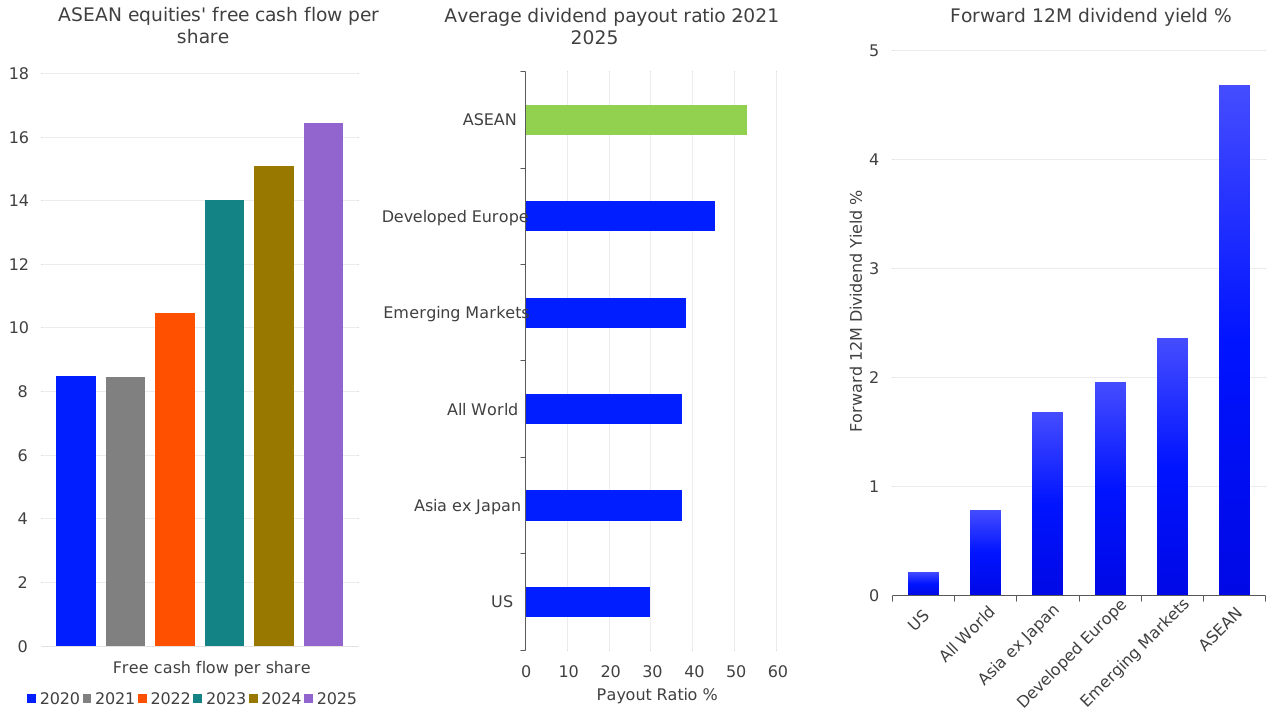
Source: FTSE Russell, LSEG Workspace, as of 31 December 2025. All World—FTSE All-World Index, Asia ex Japan—FTSE Asia Pacific ex Japan Australia and New Zealand Index, US—FTSE USA Index, Developed Europe—FTSE Developed Europe Index, Emerging Markets—FTSE Emerging Index, ASEAN—FTSE ASEAN Index. Past performance is not a guide to future returns. Please see the end for important legal disclosures.
As at the end of 31 December 2025, more than 60% of the large- and mid-cap companies in the FTSE ASEAN Index offered dividend yields above 3%, reflecting a management culture that focuses on shareholder returns: dividends have accounted for roughly half of the FTSE ASEAN Index’s total return over time.
Dividends' contribution to the total return of the FTSE ASEAN index (2001-2025)
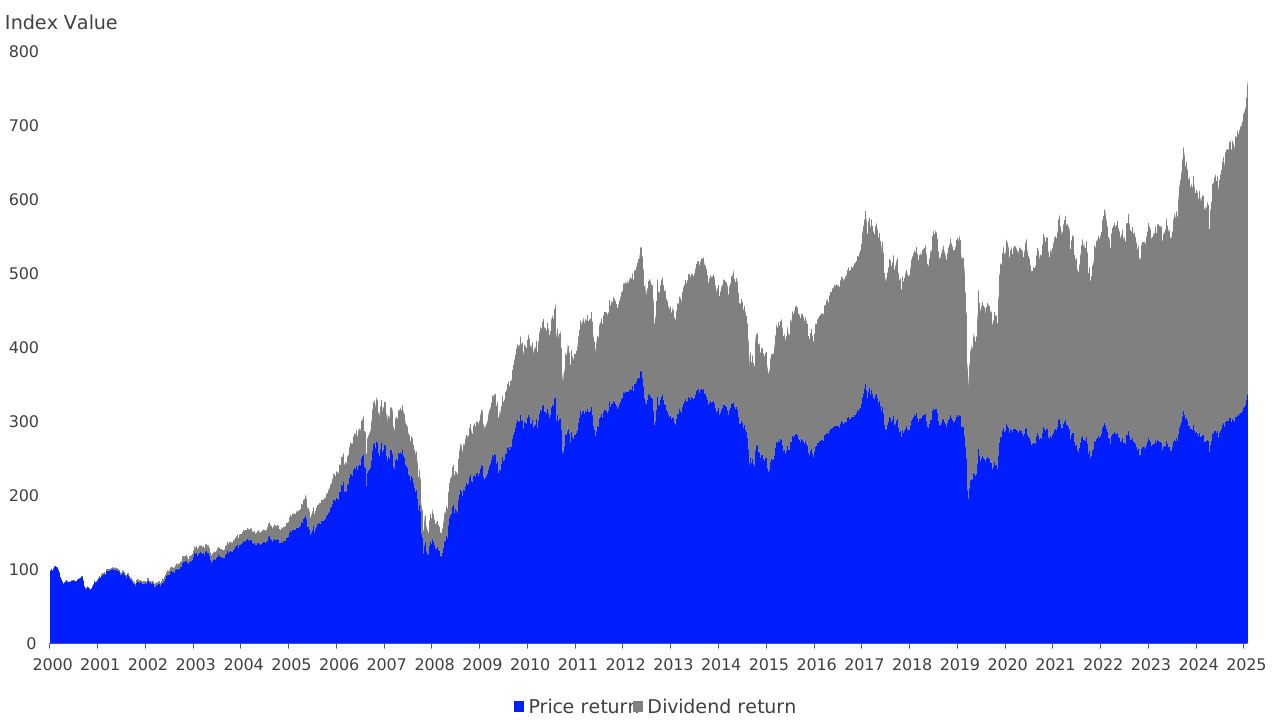
Source: FTSE Russell, as of 31 December 2025. Index value is rebased at 100 on 29 December 2000. Past performance is no guarantee of future results. Please see the end of the blog for important legal disclosures.
In an environment marked by economic uncertainty, geopolitical tensions and the prospect of declining global interest rates, investors’ appetite for reliable income streams has sharpened. Against this backdrop, the ASEAN region’s combination of attractive dividend yields, relative economic resilience and long-term structural growth stands out.
A smart way to capture ASEAN income: target dividend strategy
Not all dividend strategies are created equal, however. Traditional dividend approaches often focus on the highest-yielding stocks, which can lead to excessive portfolio concentration and above-average exposure to smaller companies or to businesses with weakening fundamentals.
The FTSE ASEAN ex REITs Target Dividend Index takes a different approach. It targets a 100% yield uplift relative to the broad FTSE ASEAN Index (excluding REITs). By removing REITs, the index emphasises companies with earnings-supported dividends and lower interest rate sensitivity.
Rather than selecting the highest headline yields, the index starts by selecting companies with a consistent dividend-paying record. Using FTSE Russell’s Target Exposure methodology—a rules-based tilting framework—it gradually increases exposure to higher-yielding companies while proportionally reducing exposure to lower-yield names.
Across multiple market cycles over the past 25 years, a back-test of the FTSE ASEAN ex REITs Target Dividend index’s strategy showed notable resilience during market downturns and lower overall volatility compared with the broader ASEAN market.
Back-tested performance of the FTSE ASEAN ex REITs Target Dividend index
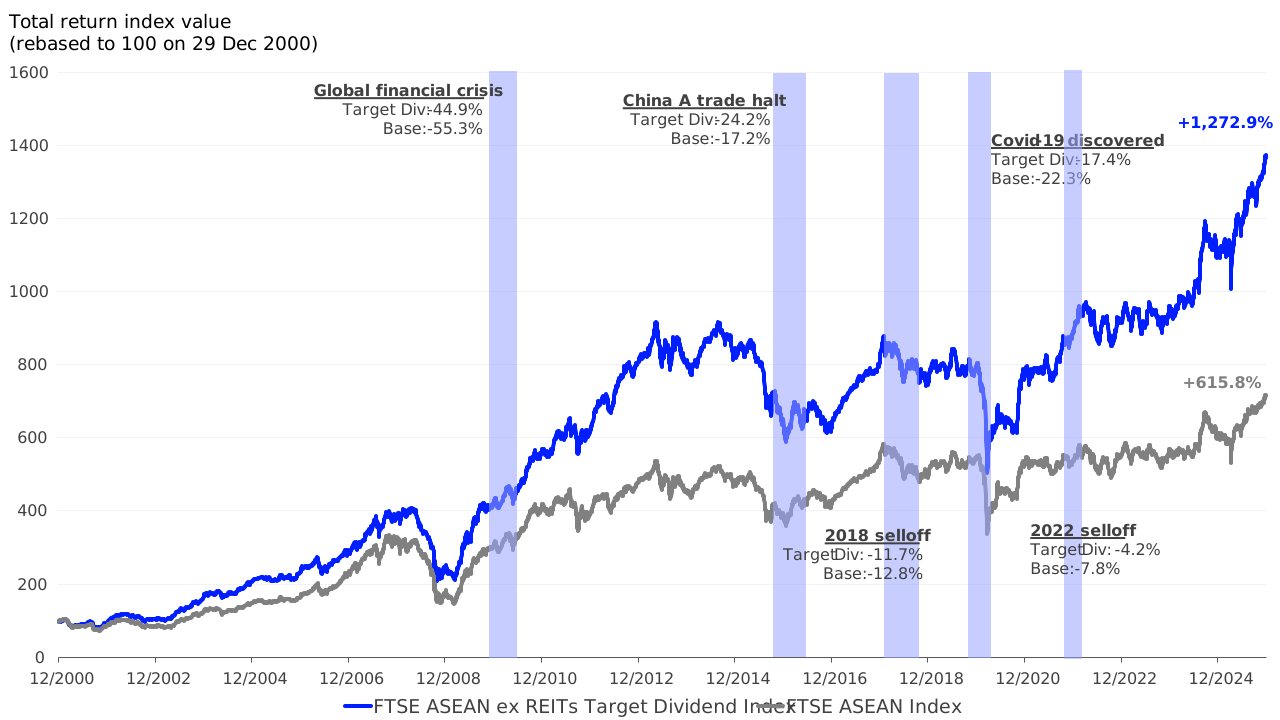
Source: FTSE Russell, as of 31 December 2025. Index value is rebased at 100 on 29 December 2000. Cumulative total return figures shown are calculated for the same period. Past performance is no guarantee of future results. Please see the end of the blog for important legal disclosures. The highlighted periods of market downturns are as follows: global financial crisis (9 Oct 2007 to 9 Mar 2009), China A-share trading halt (12 Jun 2015 to 12 Feb 2016), 2018 selloff (12 Mar 2018 to 31 Dec 2018), Covid-19 sell-off (20 Feb 2020 to 7 Apr 2020), 2022 sell-off (3 Jan 2022 to 22 Oct 2022).
While the FTSE ASEAN Index (excluding REITs) delivered an average dividend yield of 3.4% over the past decade, a back-test of the FTSE ASEAN ex REITs Target Dividend Index achieved an average dividend yield of 6.5% over the same period.
The Target Dividend strategy also offers diversification benefits. Over the past 5 years, it had a low correlation with the Russell 1000 Index (0.07) and FTSE China A Index (0.20), helping to mitigate concentration risk for portfolios heavily weighted toward US or China equities.
Be mindful of yield traps
Many dividend indices simply rank stocks by yield and pick the companies at the top of the ranking. The problem with that approach is that very high yields are often a warning sign. They can come from smaller or distressed companies where the share price has already fallen sharply — creating what we call a “yield trap”. While the yield may appear attractive, it is often unsustainable as the share price fall is an advance indicator of a future dividend cut.
To mitigate this kind of risk, the FTSE ASEAN ex REITs Target Dividend Index combines momentum scoring with a robust dividend yield Z-score. The Z-score helps identify companies with abnormally high yields, while the momentum scoring helps screen out stocks with persistently weak price performance. By combining valuation discipline with a fundamentals-aware momentum check, the index avoids stocks that look attractive on yield alone but which are under genuine financial stress.
ASEAN’s next chapter
Dividend investing in the ASEAN region isn’t just a nostalgic nod to “old-school” value strategies—it’s a strategic response to today’s global economic realities, in which dividends have reclaimed their place alongside prospects for share price growth.
Long viewed purely as a growth story, ASEAN is quietly proving it can deliver something even more compelling: cash flows today with growth for tomorrow. With rising corporate payouts, innovative income-focused index solutions and a diverse regional economic base, the stage is set for dividend seekers to reassess this dynamic region. ASEAN is no longer just a growth story—it is a dividend story whose time has arrived.

Sources
[1] The Association of Southeast Asian Nations (ASEAN) is a regional grouping of 11 states in Southeast Asia, which aims to promote economic security. Its members are Brunei, Cambodia, Indonesia, Laos, Malaysia, Myanmar, the Philippines, Singapore, Thailand, Vietnam and Timor-Leste.| Back to Note 1
[2] 12-month forward dividend per share forecast is calculated using the most recent I/B/E/S forecast DPS values prior to 31st December 2025. | Back to Note 2

Disclaimer
© [2026] London Stock Exchange Group plc and its applicable group undertakings (“LSEG”). LSEG includes (1) FTSE International Limited (“FTSE”), (2) Frank Russell Company (“Russell”), (3) FTSE Global Debt Capital Markets Inc. “FTSE Canada”, (4) FTSE Fixed Income LLC (“FTSE FI”), (5) FTSE (Beijing) Consulting Limited (“WOFE”), (6) FTSE EU SAS ("FES"). All rights reserved.
FTSE Russell® is a trading name of FTSE, Russell, FTSE Canada, FTSE FI, WOFE, FTSE EU and other LSEG entities providing LSEG Benchmark and Index services. “FTSE®”, “Russell®”, “FTSE Russell®”, “FTSE4Good®”, “ICB®”, “Refinitiv”, “WMR™” “FR™” and all other trademarks and service marks used herein (whether registered or unregistered) are trademarks and/or service marks owned or licensed by the applicable member of LSEG or their respective licensors.
FTSE International Limited is authorised as a Benchmark Administrator and regulated in the United Kingdom (UK) by the Financial Conduct Authority ("FCA") according to the UK Benchmark Regulation, FCA Reference Number 796803. FTSE EU SAS is authorised as Benchmark Administrator and regulated in the European Union (EU) by the Autorité des Marches Financiers (“AMF”) according to the EU Benchmark Regulation.
All information is provided for information purposes only. All information and data contained in this publication is obtained by LSEG, from sources believed by it to be accurate and reliable. Because of the possibility of human and mechanical inaccuracy as well as other factors, however, such information and data is provided "as is" without warranty of any kind. No member of LSEG nor their respective directors, officers, employees, partners or licensors make any claim, prediction, warranty or representation whatsoever, expressly or impliedly, either as to the accuracy, timeliness, completeness, merchantability of any information or LSEG Products, or of results to be obtained from the use of LSEG products, including but not limited to indices, rates, data and analytics, or the fitness or suitability of the LSEG products for any particular purpose to which they might be put. The user of the information assumes the entire risk of any use it may make or permit to be made of the information.
No responsibility or liability can be accepted by any member of LSEG nor their respective directors, officers, employees, partners or licensors for (a) any loss or damage in whole or in part caused by, resulting from, or relating to any inaccuracy (negligent or otherwise) or other circumstance involved in procuring, collecting, compiling, interpreting, analysing, editing, transcribing, transmitting, communicating or delivering any such information or data or from use of this document or links to this document or (b) any direct, indirect, special, consequential or incidental damages whatsoever, even if any member of LSEG is advised in advance of the possibility of such damages, resulting from the use of, or inability to use, such information.
No member of LSEG nor their respective directors, officers, employees, partners or licensors provide investment advice and nothing in this document should be taken as constituting financial or investment advice. No member of LSEG nor their respective directors, officers, employees, partners or licensors make any representation regarding the advisability of investing in any asset or whether such investment creates any legal or compliance risks for the investor. A decision to invest in any such asset should not be made in reliance on any information herein. Indices and rates cannot be invested in directly. Inclusion of an asset in an index or rate is not a recommendation to buy, sell or hold that asset nor confirmation that any particular investor may lawfully buy, sell or hold the asset or an index or rate containing the asset. The general information contained in this publication should not be acted upon without obtaining specific legal, tax, and investment advice from a licensed professional.
Past performance is no guarantee of future results. Charts and graphs are provided for illustrative purposes only. Index and/or rate returns shown may not represent the results of the actual trading of investable assets. Certain returns shown may reflect back-tested performance. All performance presented prior to the index or rate inception date is back-tested performance. Back-tested performance is not actual performance, but is hypothetical. The back-test calculations are based on the same methodology that was in effect when the index or rate was officially launched. However, back-tested data may reflect the application of the index or rate methodology with the benefit of hindsight, and the historic calculations of an index or rate may change from month to month based on revisions to the underlying economic data used in the calculation of the index or rate.
This document may contain forward-looking assessments. These are based upon a number of assumptions concerning future conditions that ultimately may prove to be inaccurate. Such forward-looking assessments are subject to risks and uncertainties and may be affected by various factors that may cause actual results to differ materially. No member of LSEG nor their licensors assume any duty to and do not undertake to update forward-looking assessments.
No part of this information may be reproduced, stored in a retrieval system or transmitted in any form or by any means, electronic, mechanical, photocopying, recording or otherwise, without prior written permission of the applicable member of LSEG. Use and distribution of LSEG data requires a licence from LSEG and/or its licensors.