
What drove global government bond performance in a year characterised by changing monetary policy, shifting yield curves and volatile currencies?
To explore these dynamics, we turn to the FTSE World Government Bond Index (WGBI), which measures the performance of fixed-rate, local currency, investment-grade sovereign bonds. The WGBI is a widely used benchmark that currently includes sovereign debt from over 20 countries, denominated in a variety of currencies. The index celebrated its 40th anniversary in January 2026.
Currency effects impacted 2025 global government bond returns
WGBI returns in 2025 reflected movements in global government bond markets and the impact of currency translation for international investors.
For investors with US dollar, euro, yen and pound as their base currency, unhedged returns showed wide dispersion, as gains and losses from foreign exchange movements either added to or detracted from local bond returns: US dollar investors with unhedged exposure to the WGBI saw a positive return of 7.55% during the year, but euro-based unhedged investors registered a decline of 5.18%.
Currency-hedged results were more tightly clustered across base currencies. The comparison underscores how, in a year marked by shifting rate expectations and active currency markets, the decision to hedge or remain unhedged was a meaningful driver of realised WGBI outcomes across different investor perspectives.
FTSE WGBI 1-, 3-, and 5-year USD/EUR/JPY/GBP returns
| USD | EUR | JPY | GBP | |||||
|---|---|---|---|---|---|---|---|---|
| Unhedged | Hedged | Unhedged | Hedged | Unhedged | Hedged | Unhedged | Hedged | |
| YTD* | 7.55 | 3.79 | -5.18 | 1.63 | 7.26 | -0.4 | 0.14 | 3.7 |
| 1 Year | 7.55 | 3.79 | -5.18 | 1.63 | 7.26 | -0.4 | .0.14 | 3.7 |
| 3 Years | 3.19 | 4.18 | -0.05 | 2.11 | 9.29 | -1.2 | -0.58 | 3.74 |
| 5 Years | -3.53 | -0.76 | -2.74 | -2.55 | 4.87 | -4.49 | -3.22 | -1.23 |
Source: FTSE Russell as of December 31, 2025. Past performance is no guarantee of future results. Please see the end for important legal disclosures.
Broad US dollar weakness
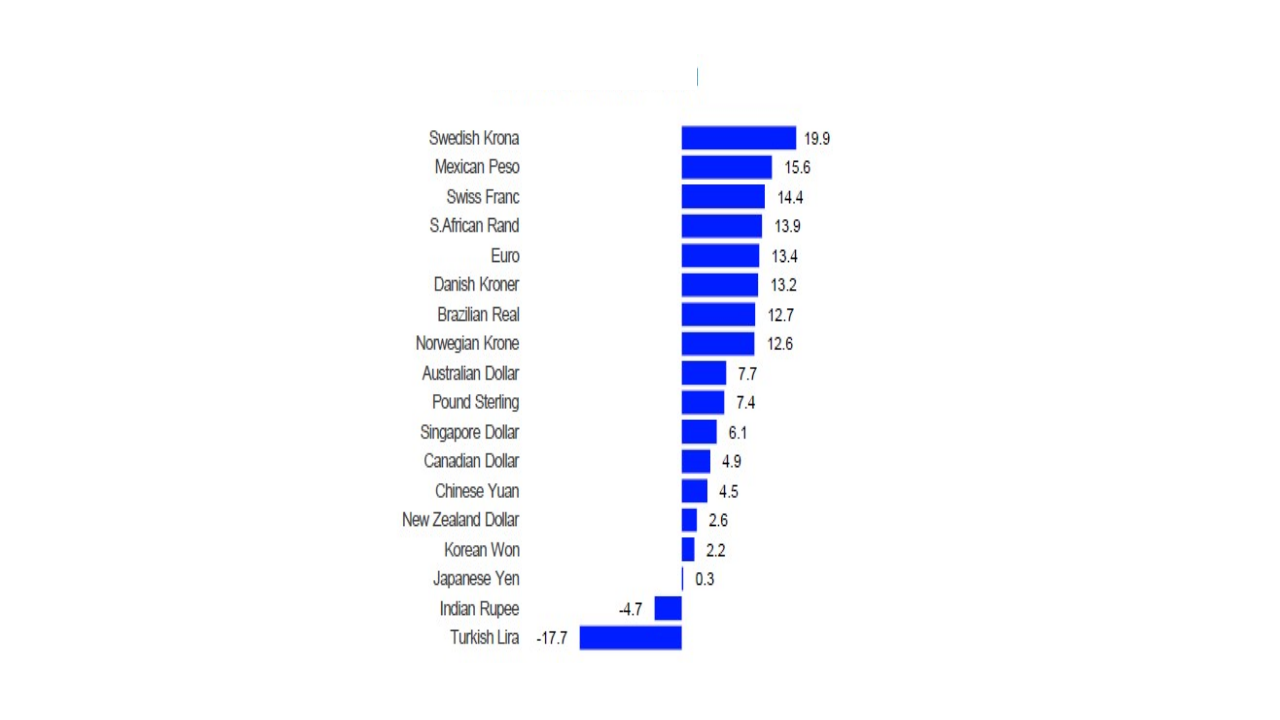
The US dollar weakened against most currencies over the 12-month period. The euro rose 13.4% versus the US dollar, supported by a more resilient than expected growth outlook in southern Europe and shifting policy expectations, as markets increasingly anticipated less easing from the European Central Bank relative to the Federal Reserve in 2026. The Swiss franc also ranked among the strongest G10 performers, benefiting from its traditional safe-haven role amid elevated geopolitical risks. The Mexican peso outperformed many emerging market peers, supported by strong trade linkages with the US and continued foreign direct investment inflows.
In contrast, the Japanese yen was among the weakest major currencies against the US dollar in 2025. The Bank of Japan raised rates in January 2025 but refrained from further tightening until December, amid tariff uncertainty. The December move was well discounted and did not spark a yen rally. Domestic political uncertainty, the continued attractiveness of US dollar/yen carry trades and limited repatriation by domestic investors kept the yen weaker than interest-rate differentials alone would suggest. Whether this dynamic continues remains a key question for 2026.
FX moves vs usd - 12m
Source: FTSE Russell as of December 31, 2025. Past performance is no guarantee of future results. Please see the end for important legal disclosures.
Diverging outcomes at the long end: UK gilts rally, Japanese government bonds lag
In 2025, long-duration government bonds delivered contrasting returns in US dollar terms, with UK 20+ year gilts rising 10.5%, while long-dated Japanese government bonds fell 19.1%.
Gilts benefited from a more supportive policy backdrop as the Bank of England’s rate cuts helped underpin a rally at the long end. Furthermore, although gilt issuance was increased for 2025-26 in the UK budget, long-dated gilt issuance was reduced, helping longer maturities outperform. In US dollar terms, 2025 returns were further supported by a stronger pound.
Japanese government bonds were among the weakest major markets, as expectations for higher issuance and the Bank of Japan’s gradual approach to tightening created upward pressure on yields at the long end. Meanwhile, pronounced yen weakness detracted significantly from US dollar-denominated returns.
YTD USD Returns (%)

Source: FTSE Russell as of December 31, 2025. Past performance is no guarantee of future results. Please see the end for important legal disclosures.
Bull steepening in US yield curve
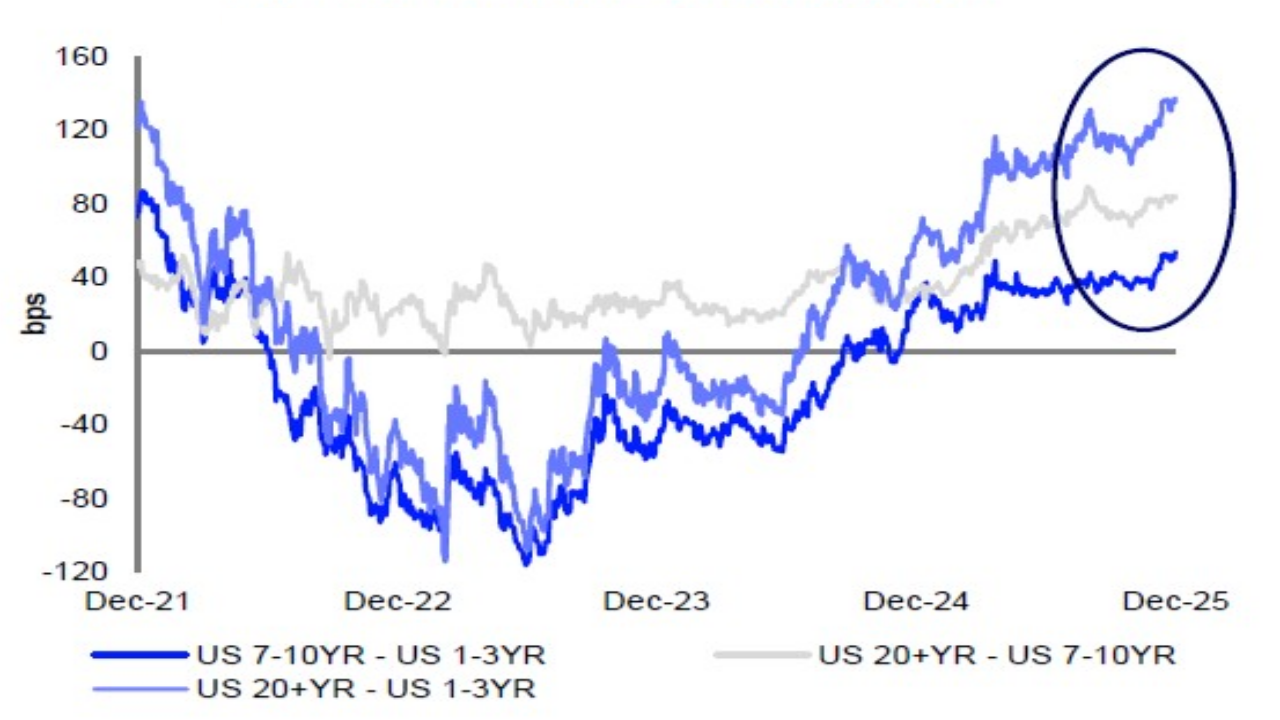
A bull steepening—where yields fall more sharply at the short end of the curve than at the long end—emerged as a defining feature of the US Treasury market in 2025, marking a contrast with the bear steepening seen in 2022–23. As policy easing progressed, yields fell most sharply at the front end, particularly in one- to three-year Treasuries. Yields in the seven- to ten-year sector also moved lower, while declines were more modest further along the yield curve, resulting in a steepening across key curve segments.
This pattern reflected a market environment in which expectations for lower policy rates pulled short-dated yields down more decisively than long-dated ones. At the long end, yields remained more anchored by structural considerations, including elevated Treasury issuance, lingering inflation uncertainty and concerns around fiscal deficits, which limited the extent of the rally.
Uncertainty around the future direction of US monetary policy may also be influencing yield curve dynamics. With questions emerging about the evolution of Federal Open Market Committee decision-making after Chair Jerome Powell’s expected departure in May 2026, term premia at longer maturities have remained relatively elevated, reinforcing the steeper curve profile observed over the past year.
us treasury yield curve spreads since 2021
Source: FTSE Russell and LSEG. All data as of December 31, 2025. Past performance is no guarantee of future results. Please see the end for important legal disclosures.
A year defined by rates, curves and currencies
Global government bond performance in 2025 was influenced by the interaction of monetary policy, yield curve dynamics and significant currency moves, resulting in different outcomes across markets and investor bases. From an index perspective, the year highlights the role of transparent, rules-based benchmarks in helping global fixed income investors examine the effects of rates, duration and currency on government bond performance.


Disclaimer
© 2025 London Stock Exchange Group plc and its applicable group undertakings (“LSEG”). LSEG includes (1) FTSE International Limited (“FTSE”), (2) Frank Russell Company (“Russell”), (3) FTSE Global Debt Capital Markets Inc. and FTSE Global Debt Capital Markets Limited (together, “FTSE Canada”), (4) FTSE Fixed Income Europe Limited (“FTSE FI Europe”), (5) FTSE Fixed Income LLC (“FTSE FI”), (6) FTSE (Beijing) Consulting Limited (“WOFE”) (7) Refinitiv Benchmark Services (UK) Limited (“RBSL”), (8) Refinitiv Limited (“RL”) and (9) Beyond Ratings S.A.S. (“BR”). All rights reserved.
FTSE Russell® is a trading name of FTSE, Russell, FTSE Canada, FTSE FI, FTSE FI Europe, WOFE, RBSL, RL, and BR. “FTSE®”, “Russell®”, “FTSE Russell®”, “FTSE4Good®”, “ICB®”, “Refinitiv” , “Beyond Ratings®”, “WMR™” , “FR™” and all other trademarks and service marks used herein (whether registered or unregistered) are trademarks and/or service marks owned or licensed by the applicable member of LSEG or their respective licensors and are owned, or used under licence, by FTSE, Russell, FTSE Canada, FTSE FI, FTSE FI Europe, WOFE, RBSL, RL or BR. FTSE International Limited is authorised and regulated by the Financial Conduct Authority as a benchmark administrator. Refinitiv Benchmark Services (UK) Limited is authorised and regulated by the Financial Conduct Authority as a benchmark administrator.
All information is provided for information purposes only. All information and data contained in this publication is obtained by LSEG, from sources believed by it to be accurate and reliable. Because of the possibility of human and mechanical inaccuracy as well as other factors, however, such information and data is provided "as is" without warranty of any kind. No member of LSEG nor their respective directors, officers, employees, partners or licensors make any claim, prediction, warranty or representation whatsoever, expressly or impliedly, either as to the accuracy, timeliness, completeness, merchantability of any information or LSEG Products, or of results to be obtained from the use of LSEG products, including but not limited to indices, rates, data and analytics, or the fitness or suitability of the LSEG products for any particular purpose to which they might be put. The user of the information assumes the entire risk of any use it may make or permit to be made of the information.
No responsibility or liability can be accepted by any member of LSEG nor their respective directors, officers, employees, partners or licensors for (a) any loss or damage in whole or in part caused by, resulting from, or relating to any inaccuracy (negligent or otherwise) or other circumstance involved in procuring, collecting, compiling, interpreting, analysing, editing, transcribing, transmitting, communicating or delivering any such information or data or from use of this document or links to this document or (b) any direct, indirect, special, consequential or incidental damages whatsoever, even if any member of LSEG is advised in advance of the possibility of such damages, resulting from the use of, or inability to use, such information.
No member of LSEG nor their respective directors, officers, employees, partners or licensors provide investment advice and nothing in this document should be taken as constituting financial or investment advice. No member of LSEG nor their respective directors, officers, employees, partners or licensors make any representation regarding the advisability of investing in any asset or whether such investment creates any legal or compliance risks for the investor. A decision to invest in any such asset should not be made in reliance on any information herein. Indices and rates cannot be invested in directly. Inclusion of an asset in an index or rate is not a recommendation to buy, sell or hold that asset nor confirmation that any particular investor may lawfully buy, sell or hold the asset or an index or rate containing the asset. The general information contained in this publication should not be acted upon without obtaining specific legal, tax, and investment advice from a licensed professional.
Past performance is no guarantee of future results. Charts and graphs are provided for illustrative purposes only. Index and/or rate returns shown may not represent the results of the actual trading of investable assets. Certain returns shown may reflect back-tested performance. All performance presented prior to the index or rate inception date is back-tested performance. Back-tested performance is not actual performance, but is hypothetical. The back-test calculations are based on the same methodology that was in effect when the index or rate was officially launched. However, back-tested data may reflect the application of the index or rate methodology with the benefit of hindsight, and the historic calculations of an index or rate may change from month to month based on revisions to the underlying economic data used in the calculation of the index or rate.
This document may contain forward-looking assessments. These are based upon a number of assumptions concerning future conditions that ultimately may prove to be inaccurate. Such forward-looking assessments are subject to risks and uncertainties and may be affected by various factors that may cause actual results to differ materially. No member of LSEG nor their licensors assume any duty to and do not undertake to update forward-looking assessments.
No part of this information may be reproduced, stored in a retrieval system or transmitted in any form or by any means, electronic, mechanical, photocopying, recording or otherwise, without prior written permission of the applicable member of LSEG. Use and distribution of LSEG data requires a licence from LSEG and/or its licensors.