

Erwan Jacob
Japan's intervention in foreign exchange markets at the end of July 2026 triggered one of the sharpest reversals in USD/JPY seen this year. After weakening beyond ¥163 per dollar, the yen recovered rapidly as authorities stepped into the market. The intervention was significant in market terms, but it did not alter the underlying forces driving the currency's longer-term direction.
The central question for investors is therefore not whether intervention works in the short term, but whether intervention can change the structural dynamics that have weakened the yen over recent years. Current evidence suggests those forces remain largely intact.
Key findings
- The intervention triggered a sharp correction in USD/JPY but left the underlying interest-rate differential largely unchanged.
- A policy-rate gap of around 250–275 basis points continues to support demand for US dollar-denominated assets.
- Lower inflation and fragile domestic demand favour gradual Bank of Japan (BoJ) policy normalisation rather than aggressive tightening.
- Fiscal constraints continue to limit the pace at which Japanese interest rates can rise.
- Intervention can affect the pace of yen depreciation, but a sustained change in trend would likely require broader shifts in rates, growth or capital flows.
FX intervention addresses symptoms, not fundamentals
The yen's outlook continues to be driven primarily by the structural gap between Japanese and US interest rates rather than by short-term foreign exchange (FX) intervention. The coordinated US-Japan intervention at the end of July 2026 triggered a sharp correction in the US dollar-Japanese yen exchange rate (USD/JPY), but it did not materially alter the underlying economic forces supporting yen weakness.
Japan continues to combine relatively low inflation, gradual monetary policy normalisation and fragile domestic demand with substantially lower interest rates than the United States. As a result, the yen remains an attractive funding currency, even as the BoJ gradually tightens policy.
FX dynamics: Rate differentials remain dominant
USD/JPY weakened beyond ¥163 per dollar in July 2026, approaching a four-decade low, before coordinated intervention pushed the exchange rate back towards ¥155. While significant in market terms, the move left the underlying interest-rate differential largely unchanged.
The primary pressure on the yen stems from the higher returns available on US assets relative to Japanese assets. Japanese investors, alongside global carry-trade participants, can continue to fund positions at comparatively low Japanese interest rates and allocate capital to higher-yielding US securities.
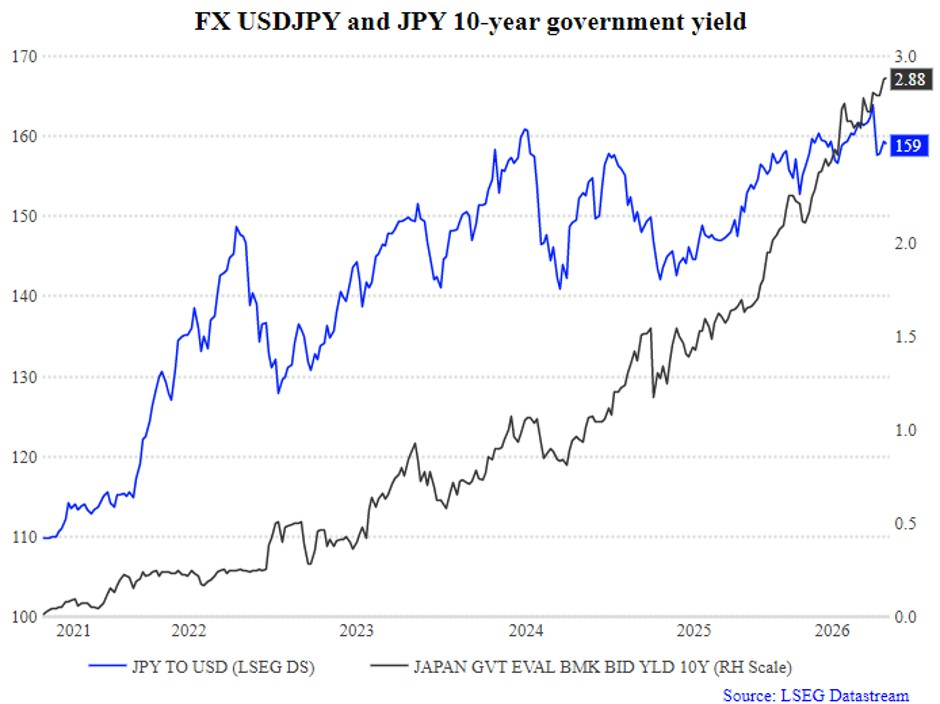
Source: LSEG Datastream. Past performance is not a guide to future returns. Please see the end for important legal disclosures.
| Year | USD/JPY Exchange Rate | Japan 10Y Government Yield (%) |
|---|---|---|
| 2021 | 110 | 0.05 |
| 2022 | 135 | 0.25 |
| 2023 | 145 | 0.70 |
| 2024 | 150 | 1.00 |
| 2025 | 148 | 1.60 |
| 2026 | 159 | 2.88 |
August data indicate a Japanese policy rate of around 1.0%, compared with a US federal funds rate of approximately 3.75%. The resulting 275-basis-point differential continues to provide a meaningful incentive to fund positions in yen and invest in US dollar-denominated assets.
More importantly, the differential increasingly appears structural rather than cyclical. US equilibrium interest rates have moved higher alongside stronger productivity growth, resilient demand and elevated private-sector investment, including capital expenditure related to artificial intelligence (AI), digital infrastructure and advanced manufacturing. Japan's neutral interest rate, by contrast, remains close to zero. Even after current policy cycles conclude, Japanese rates may therefore remain structurally below US rates. This helps explain why the yen can remain weak despite higher Japanese interest rates.
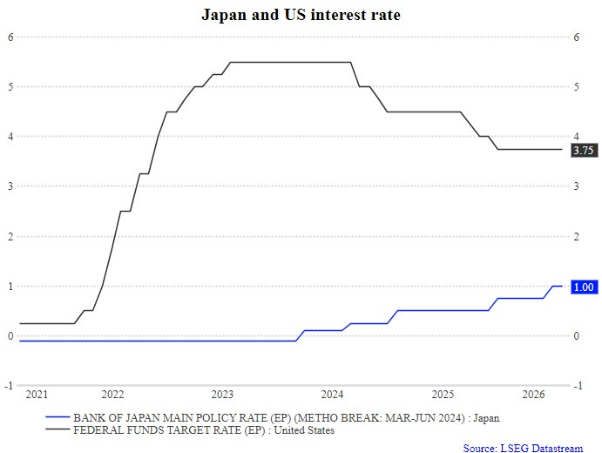
Source: LSEG Datastream. Past performance is not a guide to future returns. Please see the end for important legal disclosures.
| Year | Bank of Japan Policy Rate (%) | US Federal Funds Target Rate (%) | Interest Rate Differential (%) |
|---|---|---|---|
| 2021 | -0.10 | 0.25 | 0.35 |
| 2022 | -0.10 | 4.50 | 4.60 |
| 2023 | -0.10 | 5.50 | 5.60 |
| 2024 | 0.25 | 5.00 | 4.75 |
| 2025 | 0.50 | 4.50 | 4.00 |
| 2026 | 1.00 | 3.75 | 2.75 |
Inflation allows normalisation, rather than requiring aggressive tightening
Japan's inflation trajectory reinforces this distinction. Inflation rose above 4% in 2022, marking a significant departure from the country's long period of very low inflation. However, price pressures have since moderated.
July data showed consumer price inflation (CPI) of approximately 1.5%, while the August reading was around 1.7%. By comparison, US CPI inflation stood at approximately 3.5%.
The moderation in Japanese inflation reduces the need for an aggressive BoJ tightening cycle. While the central bank has raised rates from around zero to approximately 1%, lower inflation and relatively fragile domestic demand favour a gradual policy approach rather than rapid convergence towards US interest-rate levels.
Japan is therefore experiencing monetary policy normalisation rather than a transition to a structurally high-rate economy. This distinction is important for FX markets. Higher BoJ rates may reduce the attractiveness of carry trades at the margin, but unless Japanese rates move materially closer to US levels, incentives to sell yen and hold higher-yielding foreign assets are likely to persist.
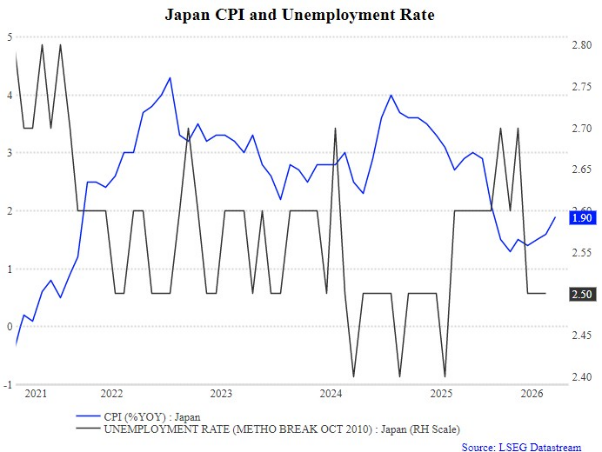
Source: LSEG Datastream. Past performance is not a guide to future returns. Please see the end for important legal disclosures.
| Year | Bank of Japan Policy Rate (%) | US Federal Funds Rate (%) |
|---|---|---|
| 2021 | -0.10 | 0.25 |
| 2022 | -0.10 | 4.50 |
| 2023 | -0.10 | 5.50 |
| 2024 | 0.25 | 5.00 |
| 2025 | 0.50 | 4.50 |
| 2026 | 1.00 | 3.75 |
Fiscal dynamics complicate the BoJ's exit strategy
Japan's fiscal position also limits the pace at which monetary conditions can normalise. Gross government debt exceeds 250% of gross domestic product (GDP), leaving Japan with one of the highest sovereign debt burdens among developed economies.
At the same time, higher Japanese government bond (JGB) yields are increasing government borrowing costs. Ten-year JGB yields have risen to their highest levels in decades as the BoJ gradually withdraws extraordinary monetary accommodation.
This creates an important policy trade-off. Higher interest rates may support the yen by improving returns on domestic assets, but more aggressive tightening would also increase debt-servicing costs and potentially weaken already fragile domestic demand.
Japan's fiscal position therefore strengthens the case for a cautious BoJ tightening cycle.
Higher JGB yields could also alter capital-allocation patterns over time. Japanese pension funds, insurers and other institutional investors have historically invested heavily overseas because domestic yields were exceptionally low. Rising domestic yields increase the relative attractiveness of Japanese fixed income and could encourage some capital repatriation. Government efforts to encourage institutions such as the Government Pension Investment Fund (GPIF) to increase domestic allocations could reinforce this trend.
However, these remain medium-term considerations rather than immediate changes to FX fundamentals.
Why Japan intervened
As USD/JPY moved beyond ¥163, policymakers faced a growing set of risks.
A rapidly depreciating yen raises the domestic-currency cost of imported goods, particularly energy and raw materials, areas where Japan remains significantly dependent on foreign supply. A weaker currency can therefore contribute to imported inflation at a time when household demand remains relatively fragile.
Japan’s Ministry of Finance authorised the operation, while the BoJ conducted market transactions, selling foreign exchange reserves, largely US dollar-denominated assets, and purchasing yen. Coordinated US participation enhanced both the scale and credibility of the intervention.
The immediate effect was substantial, with USD/JPY falling from above ¥163 towards ¥155. However, intervention can influence the exchange rate temporarily without materially changing the relative return available from holding yen compared with US dollars.
Why intervention does not alter the long-term FX outlook
For the yen to appreciate sustainably, one or more key structural factors would need to shift:
- Japanese interest rates would need to rise significantly relative to US rates.
- US rates would need to decline more sharply than currently expected.
- Japanese domestic growth and investment would need to strengthen sufficiently to retain more capital at home.
- Overseas capital allocations would need to reverse on a sustained basis.
There is currently limited evidence of any of these developments occurring on a scale sufficient to change the medium-term outlook.
Japan remains dependent on imported energy and raw materials, while pension funds, insurers and other institutional investors continue to maintain substantial overseas allocations. Meanwhile, the United States continues to benefit from stronger productivity growth, higher private investment and sustained demand for dollar-denominated assets.
The yen therefore faces a capital-flow challenge as well as a monetary policy challenge. Low domestic yields encourage capital outflows, imported commodities create demand for foreign currency and relatively higher US returns continue to attract global investment into dollar assets. Intervention can temporarily offset these pressures, but it does not eliminate them.
Conclusion
The central FX conclusion remains unchanged. Intervention can affect the pace of yen depreciation, but it is unlikely to alter the broader direction of travel without a corresponding shift in underlying economic fundamentals.
With the US-Japan policy-rate differential still around 250–275 basis points, Japanese inflation moderating rather than accelerating, domestic demand remaining fragile, and fiscal constraints limiting the scope for aggressive tightening, the BoJ has limited room to close the interest-rate gap rapidly. As a result, the structural case for a relatively weak yen remains intact.

Read more about

Legal Disclaimer
Republication or redistribution of LSE Group content is prohibited without our prior written consent.
The content of this publication is for informational purposes only and has no legal effect, does not form part of any contract, does not, and does not seek to constitute advice of any nature and no reliance should be placed upon statements contained herein. Whilst reasonable efforts have been taken to ensure that the contents of this publication are accurate and reliable, LSE Group does not guarantee that this document is free from errors or omissions; therefore, you may not rely upon the content of this document under any circumstances and you should seek your own independent legal, investment, tax and other advice. Neither We nor our affiliates shall be liable for any errors, inaccuracies or delays in the publication or any other content, or for any actions taken by you in reliance thereon.
Copyright © 2026 London Stock Exchange Group. All rights reserved.
The content of this publication is provided by London Stock Exchange Group plc, its applicable group undertakings and/or its affiliates or licensors (the “LSE Group” or “We”) exclusively.
Neither We nor our affiliates guarantee the accuracy of or endorse the views or opinions given by any third party content provider, advertiser, sponsor or other user. We may link to, reference, or promote websites, applications and/or services from third parties. You agree that We are not responsible for, and do not control such non-LSE Group websites, applications or services.
The content of this publication is for informational purposes only. All information and data contained in this publication is obtained by LSE Group from sources believed by it to be accurate and reliable. Because of the possibility of human and mechanical error as well as other factors, however, such information and data are provided "as is" without warranty of any kind. You understand and agree that this publication does not, and does not seek to, constitute advice of any nature. You may not rely upon the content of this document under any circumstances and should seek your own independent legal, tax or investment advice or opinion regarding the suitability, value or profitability of any particular security, portfolio or investment strategy. Neither We nor our affiliates shall be liable for any errors, inaccuracies or delays in the publication or any other content, or for any actions taken by you in reliance thereon. You expressly agree that your use of the publication and its content is at your sole risk.
To the fullest extent permitted by applicable law, LSE Group, expressly disclaims any representation or warranties, express or implied, including, without limitation, any representations or warranties of performance, merchantability, fitness for a particular purpose, accuracy, completeness, reliability and non-infringement. LSE Group, its subsidiaries, its affiliates and their respective shareholders, directors, officers employees, agents, advertisers, content providers and licensors (collectively referred to as the “LSE Group Parties”) disclaim all responsibility for any loss, liability or damage of any kind resulting from or related to access, use or the unavailability of the publication (or any part of it); and none of the LSE Group Parties will be liable (jointly or severally) to you for any direct, indirect, consequential, special, incidental, punitive or exemplary damages, howsoever arising, even if any member of the LSE Group Parties are advised in advance of the possibility of such damages or could have foreseen any such damages arising or resulting from the use of, or inability to use, the information contained in the publication. For the avoidance of doubt, the LSE Group Parties shall have no liability for any losses, claims, demands, actions, proceedings, damages, costs or expenses arising out of, or in any way connected with, the information contained in this document.
LSE Group is the owner of various intellectual property rights ("IPR”), including but not limited to, numerous trademarks that are used to identify, advertise, and promote LSE Group products, services and activities. Nothing contained herein should be construed as granting any licence or right to use any of the trademarks or any other LSE Group IPR for any purpose whatsoever without the written permission or applicable licence terms.