

Data & Feeds Team
- Cloud adoption can improve data access, but governance needs to be embedded from the start to avoid fragmented controls and duplicated workflows.
- For pricing and reference data, compliance by design helps financial institutions maintain trust, lineage, resilience and auditability across critical workflows.
- Cloud-native data foundations can support innovation, analytics and AI when they combine easier data access with clear control, oversight and operational resilience.
Governance must be built into cloud data foundations
As financial institutions move more data workflows into cloud environments, governance becomes more important, not less. Firms must demonstrate control over how data is accessed, used, monitored and protected. They must also manage expectations around data sovereignty, operational resilience, auditability and regulatory reporting. In this environment, cloud architecture cannot be judged by flexibility or scale alone. It must also be judged by whether it creates a trusted operating model. That distinction is important because the cloud can make data more accessible, but accessibility without control can introduce new complexity. More teams may be able to consume data, more workflows may depend on automated access, and more analytical use cases may develop at speed. Without a clear governance model, that flexibility can become harder to manage. For pricing and reference data, the stakes are high because these datasets support trading, portfolio management, risk, compliance, operations and reporting. Governance must therefore be designed into the foundation, rather than treated as a later control layer for pricing governance and reference data management.
Historically, governance has often been treated as something applied after data has been delivered, moved or transformed. That approach becomes difficult in distributed environments where data may be consumed across multiple workflows, platforms and teams. Governance can no longer be an afterthought. Controls need to be embedded into workflows, platforms and data models from day one. Security, lineage, access management and operational monitoring must be foundational, rather than a separate overlay. Cloud adoption does not automatically simplify governance. If firms replicate file-based delivery, duplicated storage and fragmented transformation processes in the cloud, they may preserve many of the same control issues that existed in legacy architectures. Data may still need to be reconciled across environments. Access may still be managed inconsistently. Lineage may still depend on manual documentation. The result can be cloud infrastructure without cloud advantage.
Compliance by design
Firms need to know where data resides, how it is accessed, how metadata is handled and how services remain resilient during disruption. These questions are not peripheral. They influence whether a data foundation can support critical workflows, regulatory reporting and auditability. Compliance by design is a response to that risk. A compliance-by-design approach starts by treating control as part of architecture. In financial markets, where pricing and reference data underpin trading, risk, compliance and operations, trust must be engineered into the operating model. DataScope Warehouse supports a model based on direct cloud access to pricing and reference data. Data can be queried using SQL within cloud platforms such as Snowflake and Google BigQuery, with availability on Databricks coming soon. Direct query models can help reduce unnecessary file movement, staging and duplicated infrastructure. That can make governance more coherent because fewer handoffs may mean fewer instances where controls, lineage and access logic could fragment.
Strong governance should not make data unusable. One challenge for financial institutions is building data controls without slowing analytics, reporting and AI initiatives. A cloud-native model can help when it brings trusted data closer to where work happens, while maintaining an appropriate access and control structure. This is the balance firms need: data that is easier to query and integrate, but still managed with clarity around permissions, lineage and usage.
Resilience is now part of the trust equation
Governance is also closely tied to operational resilience. As data supports more automated and analytics-driven workflows, institutions need the confidence that services remain dependable during disruption. Resilience is not only about uptime. It is about an organisation’s ability to maintain control, explain data use and continue critical workflows. In a market where decision windows are compressed and regulatory expectations continue to evolve, resilience becomes part of the trust equation.
From compliance requirement to strategic data foundation
Compliance by design reframes cloud-native data architecture as a strategic control point. It is not simply about satisfying regulatory requirements. It is about building a foundation that allows firms to scale analytics, automation and AI without losing confidence in how data is managed. DataScope Warehouse is a key part of this shift: a cloud-native pricing and reference data solution designed to support modern workflows with stronger foundations for governance and resilience. The firms that succeed will be those that view compliance not as a constraint on innovation, but as one of the conditions that makes innovation safe to scale.
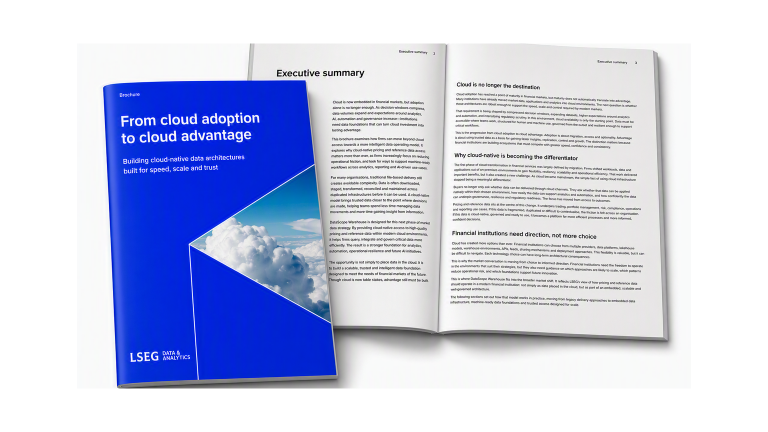
Learn how cloud-native data foundations can strengthen governance, resilience and control across modern financial workflows.

Legal Disclaimer
Republication or redistribution of LSE Group content is prohibited without our prior written consent.
The content of this publication is for informational purposes only and has no legal effect, does not form part of any contract, does not, and does not seek to constitute advice of any nature and no reliance should be placed upon statements contained herein. Whilst reasonable efforts have been taken to ensure that the contents of this publication are accurate and reliable, LSE Group does not guarantee that this document is free from errors or omissions; therefore, you may not rely upon the content of this document under any circumstances and you should seek your own independent legal, investment, tax and other advice. Neither We nor our affiliates shall be liable for any errors, inaccuracies or delays in the publication or any other content, or for any actions taken by you in reliance thereon.
Copyright © 2026 London Stock Exchange Group. All rights reserved.
The content of this publication is provided by London Stock Exchange Group plc, its applicable group undertakings and/or its affiliates or licensors (the “LSE Group” or “We”) exclusively.
Neither We nor our affiliates guarantee the accuracy of or endorse the views or opinions given by any third party content provider, advertiser, sponsor or other user. We may link to, reference, or promote websites, applications and/or services from third parties. You agree that We are not responsible for, and do not control such non-LSE Group websites, applications or services.
The content of this publication is for informational purposes only. All information and data contained in this publication is obtained by LSE Group from sources believed by it to be accurate and reliable. Because of the possibility of human and mechanical error as well as other factors, however, such information and data are provided "as is" without warranty of any kind. You understand and agree that this publication does not, and does not seek to, constitute advice of any nature. You may not rely upon the content of this document under any circumstances and should seek your own independent legal, tax or investment advice or opinion regarding the suitability, value or profitability of any particular security, portfolio or investment strategy. Neither We nor our affiliates shall be liable for any errors, inaccuracies or delays in the publication or any other content, or for any actions taken by you in reliance thereon. You expressly agree that your use of the publication and its content is at your sole risk.
To the fullest extent permitted by applicable law, LSE Group, expressly disclaims any representation or warranties, express or implied, including, without limitation, any representations or warranties of performance, merchantability, fitness for a particular purpose, accuracy, completeness, reliability and non-infringement. LSE Group, its subsidiaries, its affiliates and their respective shareholders, directors, officers employees, agents, advertisers, content providers and licensors (collectively referred to as the “LSE Group Parties”) disclaim all responsibility for any loss, liability or damage of any kind resulting from or related to access, use or the unavailability of the publication (or any part of it); and none of the LSE Group Parties will be liable (jointly or severally) to you for any direct, indirect, consequential, special, incidental, punitive or exemplary damages, howsoever arising, even if any member of the LSE Group Parties are advised in advance of the possibility of such damages or could have foreseen any such damages arising or resulting from the use of, or inability to use, the information contained in the publication. For the avoidance of doubt, the LSE Group Parties shall have no liability for any losses, claims, demands, actions, proceedings, damages, costs or expenses arising out of, or in any way connected with, the information contained in this document.
LSE Group is the owner of various intellectual property rights ("IPR”), including but not limited to, numerous trademarks that are used to identify, advertise, and promote LSE Group products, services and activities. Nothing contained herein should be construed as granting any licence or right to use any of the trademarks or any other LSE Group IPR for any purpose whatsoever without the written permission or applicable licence terms.