

Alan Francis
Financial professionals have access to more market information than ever before: breaking news, company announcements, earnings releases, regulatory filings, research reports, market commentary and alternative data sources. The challenge is no longer finding information. It is finding the right information quickly, understanding its relevance and trusting it enough to support decisions.
In fast-moving markets, more content does not automatically create better insight. It can create delay, duplication and uncertainty. Analysts, portfolio managers, traders, risk teams and data scientists need to move from headline to relevance with speed, while retaining the transparency and traceability expected in regulated financial workflows.
That is why financial news metadata has become more than a technical layer. It helps explain what a story is about, which entities and themes it relates to, how it connects to other developments and why it may matter.
Metadata is the context layer markets rely on
Metadata is often described as “data about data”. In financial news, that can include companies, sectors, asset classes, geographies, topics, events and economic indicators. Used well, metadata helps users and machines distinguish between similar entities, connect related themes and make content easier to filter and analyse.
A story about rising copper prices, for example, may be relevant not only to commodities traders but also to mining companies, supply chains, emerging market economies, infrastructure demand, inflation expectations and commodity-linked currencies. Without metadata, those connections may remain hidden. With the right metadata, the story becomes easier to discover, analyse and apply to different workflows.
Discoverability is therefore more than a search function. It is the foundation for relevance. The ability to find the right signal depends on how well financial news has been enriched, classified and connected before it reaches the end user.
Why AI makes metadata even more important
Artificial intelligence is changing how market participants consume financial news. AI models can scan large volumes of documents, summarise developments, detect signals, generate alerts and support automated workflows. But AI does not remove the need for trusted context. It makes it more important.
Without strong metadata, AI systems may struggle to differentiate between similarly named companies, understand industry-specific terminology or identify whether a piece of news is relevant to a particular security, sector or geography. They may process content quickly, but speed without context can amplify noise rather than reduce it.
Reliable AI starts with reliable inputs. Financial institutions need news content that is accurate, rights-cleared, traceable, consistently tagged and structured for both human judgement and machine interpretation. Metadata gives unstructured news the context needed to be searched, filtered, analysed and explained.
From noise reduction to better decisions
For financial professionals, the value of metadata is practical. It can reduce irrelevant content, improve alert quality, support portfolio and watchlist monitoring, and surface developments that may be missed in a traditional keyword search. It can also support use cases such as back-testing, model development, surveillance, risk management and workflow automation.
In research workflows, metadata can help identify emerging narratives by connecting co-mentions, topics and sentiment across news sources. In trading workflows, machine-readable news and metadata can support alerting and downstream analysis. In risk workflows, metadata can help teams monitor geopolitical events, supply chain disruption, regulatory change and issuer-specific developments with greater precision.
The common thread is relevance. Metadata helps users spend less time searching and more time interpreting. It makes it easier to move from “what happened?” to “what does this connect to?” and, ultimately, “what might matter next?”
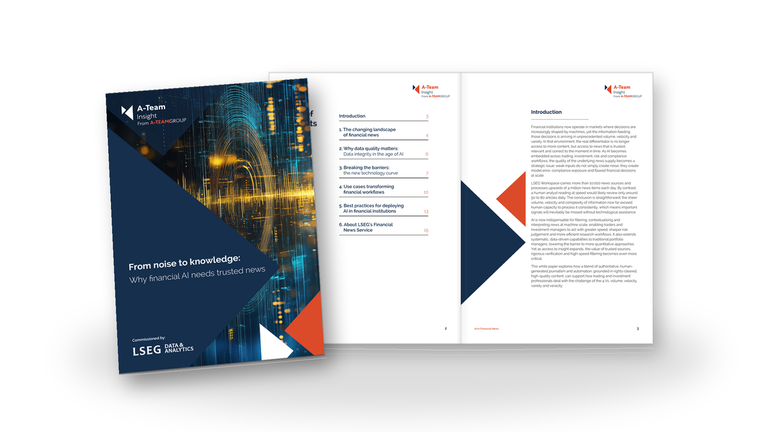
How metadata supports financial news workflows
Financial news services use metadata to enrich content from press and web sources, and authoritative, original journalism from leading news agencies such as Reuters News. Documents can be classified against organisations, economic indicators, currencies, indices and market concepts. Topic tagging, machine learning models and entity identification make news easier to search and analyse across different workflows.
This matters because financial news is not consumed in one way. Some teams rely on real-time alerts; others need structured feeds, APIs or machine-readable news for applications, analytics and automated processes. Consistent metadata helps the same content remain usable as it moves across these different environments.
As market information volumes grow, value will come not from having the most data, but from having trusted data and the ability to understand it. Metadata may sit behind the scenes, but its impact is visible in better financial news search, more reliable AI workflows, faster interpretation and greater confidence in the information being used.
In an information-rich market, context is the differentiator. Metadata brings that context to life, helping financial professionals look beyond the headline and turn market-moving news into actionable insight.

Read more about

Legal Disclaimer
Republication or redistribution of LSE Group content is prohibited without our prior written consent.
The content of this publication is for informational purposes only and has no legal effect, does not form part of any contract, does not, and does not seek to constitute advice of any nature and no reliance should be placed upon statements contained herein. Whilst reasonable efforts have been taken to ensure that the contents of this publication are accurate and reliable, LSE Group does not guarantee that this document is free from errors or omissions; therefore, you may not rely upon the content of this document under any circumstances and you should seek your own independent legal, investment, tax and other advice. Neither We nor our affiliates shall be liable for any errors, inaccuracies or delays in the publication or any other content, or for any actions taken by you in reliance thereon.
Copyright © 2026 London Stock Exchange Group. All rights reserved.
The content of this publication is provided by London Stock Exchange Group plc, its applicable group undertakings and/or its affiliates or licensors (the “LSE Group” or “We”) exclusively.
Neither We nor our affiliates guarantee the accuracy of or endorse the views or opinions given by any third party content provider, advertiser, sponsor or other user. We may link to, reference, or promote websites, applications and/or services from third parties. You agree that We are not responsible for, and do not control such non-LSE Group websites, applications or services.
The content of this publication is for informational purposes only. All information and data contained in this publication is obtained by LSE Group from sources believed by it to be accurate and reliable. Because of the possibility of human and mechanical error as well as other factors, however, such information and data are provided "as is" without warranty of any kind. You understand and agree that this publication does not, and does not seek to, constitute advice of any nature. You may not rely upon the content of this document under any circumstances and should seek your own independent legal, tax or investment advice or opinion regarding the suitability, value or profitability of any particular security, portfolio or investment strategy. Neither We nor our affiliates shall be liable for any errors, inaccuracies or delays in the publication or any other content, or for any actions taken by you in reliance thereon. You expressly agree that your use of the publication and its content is at your sole risk.
To the fullest extent permitted by applicable law, LSE Group, expressly disclaims any representation or warranties, express or implied, including, without limitation, any representations or warranties of performance, merchantability, fitness for a particular purpose, accuracy, completeness, reliability and non-infringement. LSE Group, its subsidiaries, its affiliates and their respective shareholders, directors, officers employees, agents, advertisers, content providers and licensors (collectively referred to as the “LSE Group Parties”) disclaim all responsibility for any loss, liability or damage of any kind resulting from or related to access, use or the unavailability of the publication (or any part of it); and none of the LSE Group Parties will be liable (jointly or severally) to you for any direct, indirect, consequential, special, incidental, punitive or exemplary damages, howsoever arising, even if any member of the LSE Group Parties are advised in advance of the possibility of such damages or could have foreseen any such damages arising or resulting from the use of, or inability to use, the information contained in the publication. For the avoidance of doubt, the LSE Group Parties shall have no liability for any losses, claims, demands, actions, proceedings, damages, costs or expenses arising out of, or in any way connected with, the information contained in this document.
LSE Group is the owner of various intellectual property rights ("IPR”), including but not limited to, numerous trademarks that are used to identify, advertise, and promote LSE Group products, services and activities. Nothing contained herein should be construed as granting any licence or right to use any of the trademarks or any other LSE Group IPR for any purpose whatsoever without the written permission or applicable licence terms.