
The blueprint for growth: AI’s role in Wealth Management

How data, analytics and AI are reshaping advice, advisor workflows and client expectations

Why AI matters for the future of wealth management

Artificial intelligence is moving from experimentation to execution in wealth management. Leading firms are embedding AI across the investment office, advisor desktop and client journey — not to replace human advice, but to make it more scalable, contextual and impactful.

Based on a global survey of 500 firms in top investment markets around the world, this report explores where firms are making progress, where challenges remain, and what distinguishes those generating real value from AI.

Our report explores how AI is influencing:

  • The advisor experience and productivity
  • The quality, relevance and personalisation of advice
  • Data foundations, governance and responsible AI
  • Return on investment from AI initiatives

It also highlights where firms are focusing investment today — and where gaps in data, talent and operating models are slowing progress.
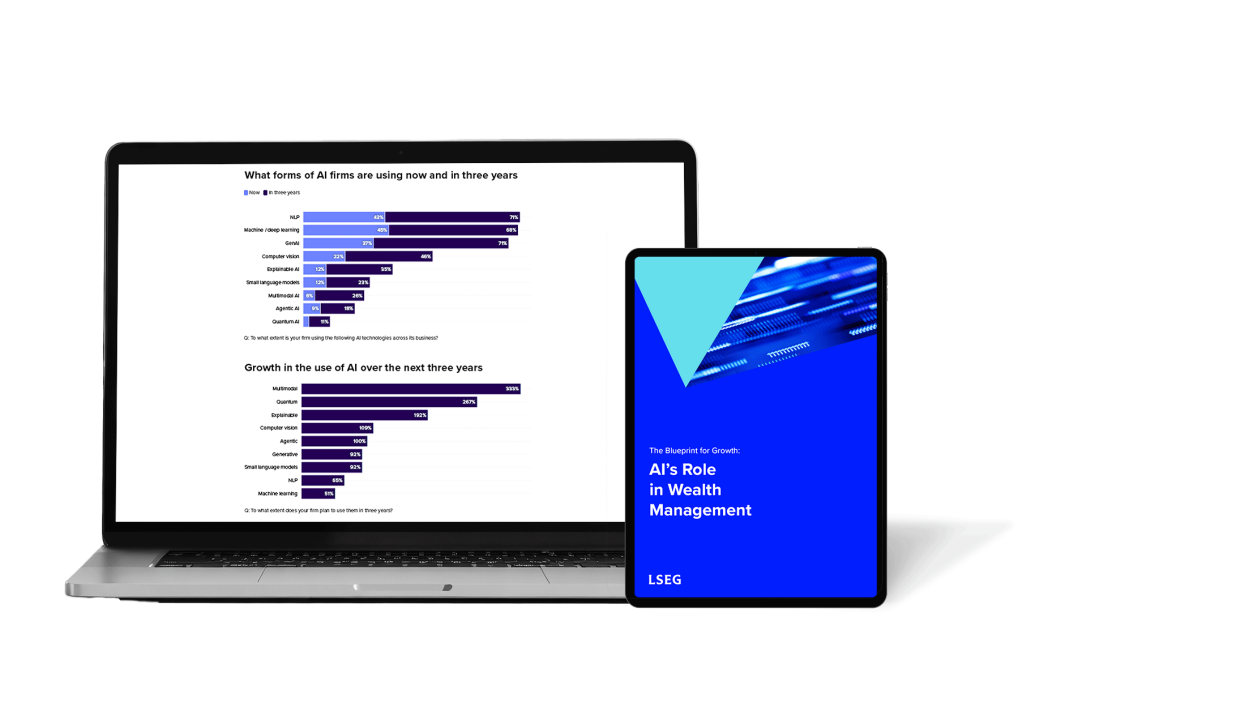
Key findings

  • 73%
    of executives say AI is critical to the future of their business
  • 78%
    of firms report progress in building an AI ready culture
  • 77%
    of firms have developed an AI strategy and roadmap
  • 67%
    have implemented governance policies to support responsible AI use

Complete the form to read the report
Read the report

Thank you for submitting your details.

Frequently asked questions

  • AI helps wealth management firms analyse data, automate routine tasks, personalise client experiences, and support investment decision-making. Rather than replacing advisors, AI is increasingly being used to augment human expertise by delivering insights, improving efficiency, and enabling more scalable advice.

  • Wealth management firms are adopting AI across front-, middle-, and back-office functions. Common use cases include client analysis, personalised communications, portfolio support, compliance monitoring, data management, workflow automation, and advisor productivity tools. Many firms are now moving from pilot projects to enterprise-wide deployment.

  • AI helps advisors spend less time on administrative and research tasks by automating meeting notes, drafting client communications, summarising documents, and surfacing relevant insights from large datasets. This allows advisors to focus more time on client engagement, relationship building, and delivering high-value advice.

  • Successful AI initiatives depend on high-quality, well-governed data. Wealth firms need accurate, complete, and timely data supported by strong data governance, lineage, transparency, security, and integration across systems. Without these foundations, AI can amplify errors, bias, and operational risk.

  • Firms generating the greatest value from AI typically treat it as a strategic business capability rather than a standalone technology project. They focus on high-impact use cases, invest in AI-ready data foundations, embed AI into existing workflows, and establish clear governance frameworks to support adoption and scale.